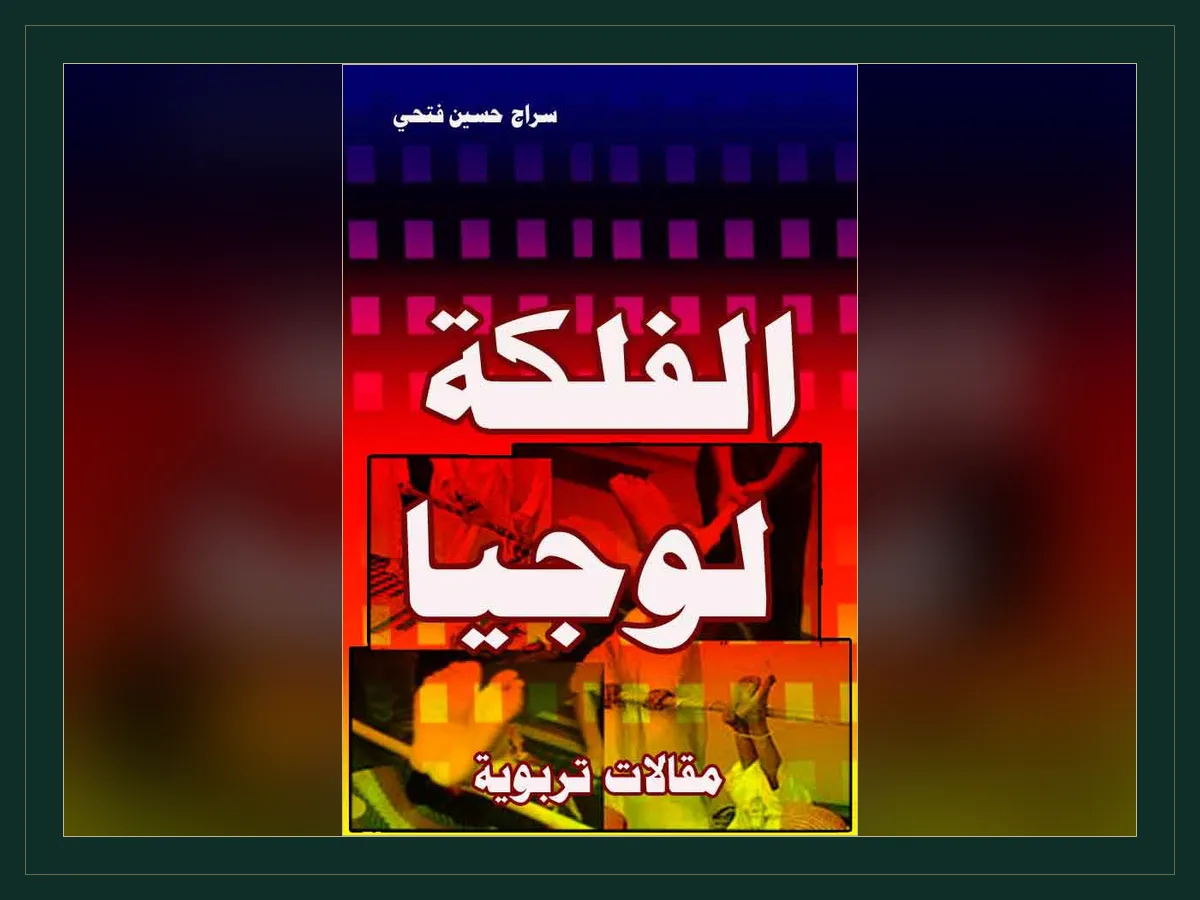
Falaka-logy: Essays on Education
Fifty essays on education by Siraj Hussain Fathi, most of them published in Al-Madina newspaper between 1414 and 1426 AH: preparing teachers and their standing, exams and curricula, universities and graduate studies, and the school, the family and society.
Dedication
To everyone who taught me a single letter and lit for me a corner of life's many corners,
and stretched out a hand to guide me along the path of goodness and right guidance. May Allah reward all of them with good, and everyone who raised their hands in prayer for me in my absence, and everyone who has carried for me
a sincere love in their heart,
and for whom I have carried in my heart a love that is pleasing to Allah, the Mighty and Majestic.
Siraj Hussain Fathi
Introduction
Glory be to my Lord, who taught man by the pen, taught him what he did not know; glory be to Him, the Most Merciful, who described Himself by mercy when He taught the Qur'an; and may Allah send blessings and peace upon the best of those who taught humanity goodness, and the finest of educators, for Allah sent him to perfect noble character.
To proceed:
This is a collection of the articles I published in my esteemed newspaper Al-Madina between 1414 AH and 1426 AH, and they revolve around educational issues. Perhaps some of the ideas, viewpoints and proposals found their way into practice some time after they were published. This does not mean that I was the originator of the idea or of the projects that were carried out; but if that was indeed so, then it is by the grace and favour of Allah, and the credit is not mine, for He is the One who grants success, who guides and who helps, and in Him I seek help, and upon Him I rely.
Let Us Be Realistic
Published in Al-Madina newspaper on Sunday, 16/5/1414 AH
One of the first articles published in the newspaper
I do not claim more knowledge than those who preceded me in discussing the question of examinations, for they are all university professors with long experience and deep scholarly research. There is no doubt that any issue debated in the media, in academic institutions, or even in public gatherings is an opportunity to benefit from personal viewpoints built on recognised scholarly foundations, alongside the individual experience bound up with public and private life.
And while the distinguished professors who enriched the discussion with their views and ideas have covered wide areas of the examinations question, I shall focus on an issue that is broader in scope than the mere question of examinations.
It is well known in the corridors of universities and of academic and educational institutions that whenever an issue is to be laid on the table for research and discussion, it must be placed in its proper framework so that it can be judged accurately and correctly. Let us take an example from the world of medicine that may confirm this principle for us: a skilled physician, when a patient comes to him complaining of a stubborn illness, does not write him a prescription like fast food; rather, he asks him to undergo laboratory tests, take X-rays and other procedures customary in the world of medicine, so that he can identify the true nature of the case after forming a complete and precise picture of the patient, and only then does he prescribe the treatment he needs.
In the same way, with any issue, whether social, economic, educational or even religious, it is a mistake to rush to pass judgement on it before ascertaining its grounds, its circumstances and its various aspects; otherwise the judgement will be premature and may lead to results we do not wish for.
As a sensitive educational issue, the topic of examinations was discussed in isolation, without going into its organic connections with other aspects of the educational process, such as the curriculum and the courses it contains, and other elements of the education system such as school buildings, the level of teachers' performance and the methods of preparing them, and the aims of each stage of schooling taken separately. All these, and others that make up what is called the education system, were almost entirely ignored during the discussion of examinations, save for rare exceptions, as though examinations were another world, separate and having no connection whatsoever with those elements. I do not think this approach has anything to do with the scientific method of discussing issues, especially when they touch the human dimension and bear on the present and future of generation upon generation; indeed, they touch the life of a great entity, the society in whose midst we live.
The ideal approach I had expected to be followed in discussing this issue was to set out the general framework that includes examinations as one of its elements, namely what educators call the education system, with all its positives and negatives, and to study it from every angle; then the role of examinations would come at the very end, because their true place is at the tail of the educational train, since they are the sum of the effort of the educational process and its conclusion.
What actually happened, however, was a leap to the end of the train and a circling around examinations. And in the end, what happened? What was the outcome, or outcomes, of those discussions? Will examinations be abolished entirely or partially?
I do not think anyone would dare assert that examinations are unnecessary, for despite everything in them they are "a necessary evil", and that is the very least one can say.
There are other solutions to the issue that must be reached, but only after discussing the other aspects and other components of the education system. So let us be realistic, let us be practical, let us be more scientific.. with apologies to the distinguished professors..
The Teacher: Standing and Care
Published in Al-Madina newspaper on Tuesday, 8/7/1414 AH
Talking about the preparation of teachers is not an intellectual luxury, as some may imagine, nor is it a way of filling empty space. Indeed, it is not honest in the least for anyone to write about this issue merely to occupy his own spare time or that of others. The preparation of teachers is a highly sensitive process; perhaps it equals, or even surpasses, the preparation of doctors, let alone others. There is no doubt that every working group in society fulfils a need that no other can meet.
If doctors take care of the individual's body, and soldiers protect the state's home front and its borders, then teachers provide society, with all its working groups of doctors, soldiers and others, with the chance of a free, dignified and balanced life.
The teacher may feel somewhat neglected by many quarters, official or popular, even though everyone is convinced of the importance and sensitivity of his position; yet this "everyone" has not managed to make the teacher feel that importance. Let no one think we are asking for hands and heads to be kissed so that society's regard for the teacher may show. What we would like is to provide the resources that help him do his work as well as possible, and by resources we mean every element connected with the educational process that bears directly or indirectly on educational performance, such as school buildings suitable in quantity and quality, equipped with what enables the teacher to fulfil his role. Within this framework fall: 1. Classrooms: their size, lighting, ventilation, and location within the school building. 2. Laboratories: their needs, size and location. 3. The school library: which must be continually renewed, with its
human, intellectual and scholarly needs provided. 4. Playgrounds: which provide the pupil with all the kinds of games and activities he needs according to
his stage of schooling, as well as their material needs. 5. The timetable: which must provide the teacher with balance, so that he is given his share
of physical and mental rest, while at the same time the rights of the pupil, the school
and the syllabus are not neglected. 6. Administration: an important element in the educational system, for the more successful the administration is in
keeping things in order and providing psychological, academic and social balance in the school as a whole,
the more the school is marked by success. 7. Curricula: by which I mean everything that affects the educational process, such as the set textbook,
extracurricular activities and teaching aids. These are elements that play an important role in
the educational process and in the level of performance of teacher and pupil alike, because they are the raw
material that is shaped by the teachers' hands and then becomes ready in the hands of
the pupils.
These elements we have listed are some of what are known as the elements of the education system. By providing them, together with other elements such as suitable housing for the teacher, which ought to be close to his place of work, as is the case at some of our universities and in many countries of the world, where housing is on campus and offers all the services and family needs of the teacher: schools for sons and daughters are at hand, along with shopping centres, postal services and the like; in other words, the university professor lives in a city complete with facilities, and does not carry the worry of his children's schooling and of getting them there. With these services available near his home, he can save enough time to devote further effort to developing his academic performance.
When we ask any teacher, whoever he may be, to raise the level of his performance, we wrong him if we do not provide him with the essential and basic needs we have just set out. Let the primary-school teacher be the sample we speak of in these lines.
The preparation of the primary-school teacher stands almost apart from the preparation of teachers for the other stages, given the sensitivity of this stage and its importance in laying the foundations of the individual's personality, for it begins with him in his childhood. As the saying goes, the child enters primary school as a blank page on which the teacher's fingerprints are impressed, and so the features of this little person's character are set. If we truly believe in the teacher's importance in forming the pupil's character, are we right to pay him no heed when it comes to caring for his preparation..?
We may not all agree on a single opinion about this issue, and a unanimous opinion is not necessary as long as the field is open to all and each has his view. But those who have lived through the preparation of primary-school teachers for many years must surely have formed a nearly mature picture of that process, with its negatives and positives, and of its real needs that must be provided, or the needs that have been provided.
Going into detail on this issue will not be easy, for it requires realistic, practical field studies, not merely a newspaper article like this one, or academic research whose aim is promotion and which is then tucked away in drawers with no further existence in the world of practice.
Through these lines I call on the authorities responsible for education in our country to commission specialists, university professors, practising educators, education experts and those concerned with this issue, to carry out serious research and studies with one specific and clear aim: raising the level of performance of primary-school teachers.
Once these studies and research are complete, the information gathered should be examined by specialised committees to draw up an integrated strategy that takes the matter from every side and does not focus on one part to the exclusion of another, so that a complete picture of the preparation of the primary-school teacher is formed. Then proposals and recommendations can be drafted that can actually be applied and benefited from, and so we reach the stage of mending what can be mended, or of following a path of radical change and complete correction. I hope we will not resort to patchwork, or to the "teacher of necessity" method.
A question mark..??
Here I want to place a large question mark over this issue: what does the primary-school teacher really need in order to raise his level of performance..?
There may be some attempts to answer this question, such as:
- Raising teachers' salaries. But reality may suggest that a raise is unnecessary, for teachers have a career ladder and salaries that many envy them for, and the current financial benefits are good to a large degree and do not, in my view, need a further increase. So what is required, then..?
Someone may say: raising the level of academic qualification..!
But some will comment that this is not necessary at present, even if it is the better course, since the higher the level of academic and pedagogical qualification, the better the performance, or so it should be. And since the present qualification, the "bachelor's degree", is considered sufficient, at least for the time being, raising the level of academic qualification is not pressing; bearing in mind that our future plan must include raising it to the master's, and even the doctorate. If some are not convinced of this now, time will convince them.
Another may propose: good housing close to the workplace must be provided. That is no doubt a good proposal if it is feasible. Many other proposals may appear on the horizon, and reviewing and discussing them may take up our time. But why do we not leave the field to those who will be commissioned to study the issue in an integrated way, from all its dimensions, and then arrive at suitable recommendations which, we hope, will, when applied, solve the educational problems that have now come to the surface?
A pause with a question: if those proposals, or others, are not what is really needed, then what needs are essential for raising the level of the teacher's performance..?
I will not speak about the answer in detail, for we have already mentioned that its place is not a newspaper article that may or may not be read, or of which only a few sentences and words may be read. So I say again: this is the work of a committee officially commissioned by the authorities responsible for education in our country, which would carry out realistic scholarly studies and research, after which its recommendations and proposals could be applied. But..!!
But I would like to whisper in the ear of whoever has a heart or gives ear while he is present, and say a word or two that were said by a poet, one of those whose verse has become proverbial wisdom:
The teacher and the physician both, when not held in honour, are of no avail
As we said before, honouring the teacher does not always mean merely raising salaries, even if that is called for; but the teacher and his brother the physician will not give fruitful service if they do not feel honoured, honoured by every party with which their work connects them.
The school administration, or the education departments, indeed even the Ministry of Education itself, must treat the teacher with refined humane treatment that makes him feel his humanity, and not deal with him like a machine whose energy is drained to the utmost and which, once its working life is over, is thrown on the rubbish heap.!!
I want to ask any teacher, at any stage of schooling: does he feel his humanity in his dealings with the school administration? Does that administration make him feel that he has physical and mental energy with limits, or does it regard him as a mere employee tied to a full working day, even though he usually carries home with him the worries of his school and his pupils' exercise books, spends hours at home preparing lessons, and, when the term ends, spends hours upon hours marking answer papers and reviewing them?
There is no doubt that these tasks are at the very heart of the teacher's duty, and sincere teachers may find pleasure in performing them; but we must appreciate those efforts. Would the school administration be committing a grave error if it kindly granted certificates of appreciation to the diligent who exert more effort than others? Often a kind word is enough, for it is charity, it is love, and it is an incentive to more work.
Dry administrative treatment, too, has its negative effects deep within the teacher. If he is absent through illness or an emergency, or wishes to take emergency leave, he may find the doors shut before him and his excuses unaccepted; indeed, he may be handed over to one of the administrators to be investigated..!!
Holding people to account for shortcomings is not a wrong procedure; rather, there must be reproach in the kindest way, and then appropriate administrative measures towards the negligent and careless. The educational field must be rid of negligent and lazy leaders, and by these leaders I mean teachers first and foremost, because they are symbols and role models for our children. If any of them are marked by negligence and indifference, they are not fit to remain in the field of teaching and the arena of education.
An administrative system is unavoidable, for it regulates work, sets its course, and gives everyone his due. And since human nature, when weakness gets the better of it, will destroy energies and wreak ruin where reform is sought, there must be accountability, indeed there must be punishment; but there must also be the other side, the side of reward. Just as we call, and insist, on holding the negligent to account, we likewise call for rewarding the hard worker.
There is no doubt that training oneself to seek reward and recompense first from Allah, at every level, whether one is a principal, a teacher or even a pupil, is the fundamental thing; but people must also be thanked, and the least that can be done, as we said before, is a kind word!!
Some principals do not feel their standing as firm and resolute principals, in their own eyes, unless they frown and scowl, snap and huff; and this, in the view of sensible people, is the greatest proof of their failure..!!
Nor is the successful principal the one who cheapens himself before those who work with him, given to silly joking that may in the end push the weak-souled to exploit these gaps, so that self-serving friendships form. And since the talk is not only about administration and the principal, I have mentioned this merely as an example, because of the negative or positive effect the administration has on the staff's morale; the administration is the body the teacher rubs shoulders with directly, and because of the importance of this relationship in the teacher's life I have given this example.
Teachers' Colleges.. Where To..?
The body now supervising the Teachers' Colleges is the Ministry of Education, a ministry that has lived with teacher preparation since its very beginnings in 1345 AH, in the form of the Saudi Scientific Institute in Makkah. Development and renewal in this field continued until today the Teachers' Colleges are spread across many parts of the Kingdom, numbering some eighteen colleges, and their graduates now receive a bachelor's degree in primary education.
This great leap in teacher preparation is a pioneering step, academically and educationally. Anyone who has followed this field from its first beginnings to this day will find that the Ministry of Education has made no small efforts to develop and raise the level of preparation and performance of the primary-school teacher. I mention, for example, the real attention paid to the Teachers' Colleges, especially in recent years; were space not so limited I would cite several examples in detail, but it is enough to mention the regular meetings between senior ministry officials and the college deans to follow up on the work, the changes, and the colleges' emerging and ongoing needs, and then to approve whatever needs approving. Those who work in the colleges know that attention best.
Yet despite these efforts, one who has lived through the various stages that the preparation of the primary-school teacher has passed through finds that duty now demands a rethinking of the manner of care, supervision and administration. We may even go so far as to call for the higher administration to be transferred to a body more specialised and better suited to university study. The Ministry of Education needs to devote itself more to the lower stages of schooling (primary, intermediate, secondary), and these stages grow wider every day, and with every growth they need their new requirements met and continuous care, so that they reach a high level of performance, academically and educationally.
Hence the need to reconsider the nature of the body supervising the Teachers' Colleges, which have now become genuinely "university-level", are subject to the university regulations, and award their graduates the bachelor's degree. They belong, "by force", to higher education, and so it has become self-evident that supervision of these colleges should be transferred to a body other than the Ministry of Education.
This body need not be the Ministry of Higher Education, for we now have seven universities, and some of them have colleges of education similar to the Teachers' Colleges, except that they specialise in education above the primary level; that is, they have sufficient experience and capacity to run the Teachers' Colleges.
Nor need all these colleges belong to a single university. Our universities are distributed regionally in a balanced way, which means that each college could be attached to the university nearest to it, and might even adjoin it, as is the case with the Teachers' College in Makkah, which actually neighbours Umm Al-Qura University.
Nor would it be strange for all the Teachers' Colleges to come under the umbrella of one of our seven universities, each college being a branch of the mother university. There is another proposal: to form an independent university gathering all these colleges under its umbrella; on that day we would have a university distinguished in both quality and quantity.
These are merely proposals that sprang from a sense of the need for renewal and change in the administration of the Teachers' Colleges, a sense formed over years of living the reality of the intermediate college and then, finally, of the Teachers' College where the writer of these lines works; and before that, of living the College of Education in Makkah during my university studies. That college was at the time under the umbrella of the Ministry of Education, then passed under the umbrella of King Abdulaziz University in Jeddah, and finally became part of Umm Al-Qura University in Makkah.
While we were students at the College of Education in Makkah, a feeling grew in us that the supervising body had to change; and when this indeed happened and the college came under King Abdulaziz University, we felt a radical change in every respect, academically, culturally and socially.
And so, the sense of the need for change of which we have spoken is no product of chance or mere illusion; it is the truth, which we hope will see the light, even if after a while, because the Teachers' Colleges now belong to higher education, and this kind of education needs a wider vision and a body more specialised and more aware of the requirements of the academic stage. May Allah guide everyone to what He loves and is pleased with.
An Educational Council in Every Region
Published in Al-Madina newspaper on Wednesday, 29/8/1414 AH
Man is distinguished from all other creatures by his capacities for growth and development. These capacities are strongly bound up with the educational process, which is wide in scope and deep in reach, and has many dimensions rather than a single one. Many elements share in influencing the human being, directly or indirectly, beginning with his own self and ending with the universe around him. In any human society we find that education is carried out by several bodies, among which roles are distributed, each according to its specialty, and according to the needs of the individual and of society.
If it is self-evident that several bodies take part in the educational process, then it is essential that there be coordination and organisation among them, which cannot be regarded as a supererogatory effort or an optional, non-binding choice.
This interconnection and mutual support has become indispensable for providing the right climate for a mature educational process, since the upbringing of the individual needs integrated planning that provides for all his needs according to the resources available and according to society's aspirations and development plans. For the individual is the nucleus of society; indeed, he is the axis around which all development processes and plans revolve, and so it was essential to provide a comprehensive, integrated plan that serves this individual.
Having an educational council in every administrative region of our dear country has become a civilisational necessity that need calls for and our great ambitions drive us towards.
As is known, in every administrative region there is an education department (for boys and for girls) that provides all the material, human and other needs of the education sector. Today, in most regions of the Kingdom, there is more than one educational body and institution, not just an education department: there are universities or their branches, there are Teachers' Colleges, and at the same time there are experienced educators as well as many people interested in the educational process.
This multiple "presence" of bodies connected with education and teaching makes integrated coordination among them necessary, because all these institutions work towards one goal and walk side by side along one road. Let us take as a model of this multiple educational presence a region such as Madinah al-Munawwarah, upon its resident be the finest blessings and peace, where there is a group of educational bodies: the Islamic University with its many colleges, the College of Da'wah (a branch of Imam University), the Teachers' College under the Ministry of Education, the College of Education under King Abdulaziz University in Jeddah, the Boys' Education Department, the Girls' Education Department, and a number of interested individuals and people of educational experience.
This beautiful educational mosaic in a single administrative region provides good elements for establishing an educational council that serves the region in an orderly, coordinated manner, built on the principles of integration, cooperation and closeness; because the present situation is, quite simply, marked by a lack of integrated academic relations; indeed, some of those working in these sectors know nothing about any body other than their own workplace.
The call to form an "official" educational council in every region, under the direct supervision of the head of the local council and in direct contact with the council's chairman, "the Emir of the region", would, Allah willing, play an effective role in developing and maturing the educational process in every region.
I am not calling for a council of reckoning and reproach and of shifting blame onto others; rather, I hope for a council that plans, organises, provides, and coordinates between the needs and the capabilities of the region's educational bodies, and helps everyone face educational, pedagogical and social problems, because it would include society's elite and its educational leaders, who would strive with all the knowledge and experience they have to reach what is best educationally. And this is what the sincere want.
The responsibilities and details of this project cannot be made clear by one article or more, because that is the work of a joint committee commissioned by the competent authorities to devise an agreed formula and begin working with it, so that we may, by Allah's power and help, achieve the aims we hope for from the establishment of educational institutions in our beloved country. May this council _ or councils - become a crucible in which efforts meet and hearts unite for the rise of advanced educational work. May Allah guide everyone to what He loves and is pleased with.
The Individual.. or the Method..?
Published in Al-Madina newspaper on Saturday, 16/9/1414 AH
Among the axioms taught in many scientific and humanities disciplines is what is called the systems approach to managing and running institutions. And among the things whose importance and necessity are beyond dispute is that the "one-man" approach is rejected in most places across the expanse of human life, generally speaking.
For the absolute dominance of one individual within a single household or institution is no sign of that household's happiness or that institution's success; rather, it may often be one of the dangerous indicators of shabbiness, family collapse and administrative failure.
When university students and others study methods of administrative work, they learn about the patterns and forms of management, their negatives and positives, and then question marks rise in their minds as to which of those methods is best, and whether they are applied by the professors in the lecture hall itself, and at the level of the college or university administration. And should anyone happen to ask the staff of some institutions about the nature of the administrative work there, it would be very easy to know how far the administration has succeeded or failed, from the viewpoints of those staff and their questions about the institution's administrative style.
Among the things that have become well known and familiar is that if the top official in an administration is replaced by someone else for any reason, one notices in that administration a change in working style, which may be total; and if this person too is replaced by another and another, a change in style is bound to occur.
This is without doubt a cause for wonder, as loyalties and orientations change, and perhaps even the colours of the cars change, which is what provokes disgust, since stability is missing from working life in this institution or that; right turns to left and north to south, and glory be to the One who changes all states.
This does not mean that we reject renewal and the correction of mistakes; what is required is a clear constancy of method, and what is rejected is attachment to the individual, for that is the calamity of calamities, because individuals are not constant, no one has been granted immortality or freedom from error, and no one has ever possessed a sanctity that would make others attach themselves to him.
A clear method, with defined features and aims and mature practical procedures, that protects the individual and others from falling into errors or repeating them; and a group surrounding the top official that supports him properly, does not drum his praises, and helps him competently and sincerely to carry out his tasks: this is the ideal way to a successful working life.
The lack of it means floundering, randomness, and material and human loss. This can only be achieved by laying sound and correct foundations built on precise scientific study that applies the principles for establishing or founding institutions, and also by choosing the "individual" and choosing the "others".
That is, team-building must be on sound foundations, free of any personal impulses and influences, and this choice must aim at the interest of the work first and last, not the interest of individuals. Just as the choice must be sound, so too the working style and the motives for work must be sound.
For the aim of all this is that we should have a working system whose parts and elements complement one another and interact so that the relationships are reciprocal, integrative and positive, not one-sided and negative. The proof of this is in the hadith of the Messenger of Allah, peace be upon him, ("like a single body"), where there is complete interconnection among all the body's organs in performing their functions and in the interaction of their secretions, so that each organ fulfils the role required of it.
When the body is like this, it is described as healthy; but if a defect occurs in some organs or their functions, the body is described as sick and needs treatment.
So too administrative work, whatever its level: if interconnection is present in it, it is nearer to health; but if signs of disorder appear in its details and among its staff, it is nearer to collapse and needs treatment, and patchwork will be of no avail.
What one notices in many institutions is that when the top official changes, a change in the administrative line-up is expected, followed by a change in all or part of the working style, which affects many aspects within the administrative structure or the public dealing with that institution. Matters may reach the point of complication, or the exact opposite: laxity and the waste of time, effort and money.
Let Us Tear Out These Pages
Published in Al-Madina newspaper on Saturday, 30/9/1414 AH
The nature and forms of relationships among the members of society differ according to the kind of people involved and their academic, social and economic standing. Yet however the forms and content of these relationships may differ, they cannot do without being surrounded by a fence of "humaneness" that provides an atmosphere of reassurance and peace of mind for the individuals dealing with one another. This term "humaneness" is not among what appears in the Holy Qur'an or in the purified Prophetic Sunnah, but we find in them some gentle, tender terms that carry within them the highest levels of what we today call humaneness: we find "love", "gentleness", "familiarity", "affection" and "mercy", which form a wealth of refined relationships that bind hearts together, bring the distant near, and indeed cut off the way for the devils among men and jinn when they try to muddy the bonds between members of society.
Some of the relationships that actually exist among people, whether at the personal level or at the level of those working in public and private institutions, are clouded by a dark fog and dominated by elements that sour them. Perhaps among the causes of this fog is some people's misunderstanding of others; and among them too is some people's belief that they must always take a contrary stance towards others, especially in dealings between subordinate and superior. There is no explanation for such a stance other than the application of the corrupt principle "be contrary and you'll be noticed"..!
These forms of contrariness appear in many areas of human life, beginning with domestic relations between husband and wife, or among the children themselves, and on to officials and those who work with them in public and private institutions. If each person were to pause frankly with himself, to discover his own hidden depths, what he wants from others and what he owes them, and then use a sound standard by which to weigh his conduct towards them, he would most certainly find the doors of hearts open before him, and it would not be hard to enter them with love, affection and mercy. And if a person, in his place on the expanse of life, looked around him and knew the role he must play as a brick in the great human edifice, he would have no spare time for quarrelling or making life miserable for others; rather, time, with all its wide expanses, would grow narrow for him under the weight and density of his duties. Human life needs every effort, thought, feeling and energy, and the road of civilisation is long and arduous and cannot do without any individual belonging to the human community giving of his effort, time and thought.
If a person fills his time and his heart with the concerns of humanity, and his aim is to rise to the lofty peaks in every sphere of life, he will strike out from his life the pages of cunning, scheming, hatred and envy of others, and from the book of his life the pages of stubbornness and contrariness towards those around him "without necessity". On that day, relations among human beings will be built on those upright rules and principles that came in the divine method and were applied by the Messenger of Allah, upon him be blessings and peace, and his Companions and those who followed them in goodness. So can we tear out the dark pages of our lives and replace them with other, luminous pages?
The Arab Mind.. Who Will Save It..??
Published in Al-Madina newspaper on Saturday, 7/10/1414 AH
"The mind", whatever its race and homeland, is a gift from Allah to man; by it he is distinguished from other creatures, and it is what made him the bearer of the great trust and Allah's vicegerent on His earth. If the mind has attained a standing that nothing else can rival, it is because it is what distinguishes one human being from another; it is one of the five essentials that all humanity agrees on protecting and preserving, and without the slightest doubt it deserves all respect and honour.
The respect that must be given to the mind does not reach the point of sanctification, as some pretenders to awareness and thought have done, making it a god; and at the same time it is in no way permissible to belittle it. The mind, like any wealth Allah grants to man, must be protected and guarded from the hands of meddlers, thieves and intruders.
Whoever surveys the state of the mind in our Arab Muslim world will find a strange paradox that cannot be justified in any way: it has become the victim of a cunning conspiracy plotting against it, until it has been put in a position no one would envy, for it lacks the least of the honour and esteem it deserves.
The honour the Arab mind needs is not confined to one form or a limited space; the care must cover all directions and all levels: at home among the members of the family, as at school, in the street and through the media. None of these levels may neglect to give sufficient room to respecting and revering the blessing of the mind that Allah has given us.
The kind of respect we want to shed light on, and that all the sincere wish to see brought into being, lies in the educational and instructional programmes the school offers to help the mind through the various stages of growth to become mature, useful and responsive to the changes and new developments of life, supporting its innate and acquired abilities, through which it contributes to supplying humanity with the fruitful, constructive thought and knowledge it produces.
The respect required for this mind also includes the media offering what helps it reach the best degrees of maturity and awareness of the changes and events taking place in the world around it, and at the same time no contradiction arising between what it is given at school and what the media present, whatever that may be. Harmony must be the hallmark of what is offered, not only through these two channels but through all the means that influence the guidance and upbringing of the individual's mind.
There are many other fields that can contribute very effectively to enriching and maturing the mind and turning it into a constructive energy in its great human society, instead of pressing it by many means and confining it in a small, narrow bottle from which it sees no sunlight and in which it cannot obtain the oxygen of a healthy life.
In the course of honouring and caring for this Arab Muslim mind, we must look at it with wide eyes and open hearts, so as not to drop it into snares it can well do without, while preserving the distinctiveness that sets it apart from others.
All human minds share many traits, but Muslim minds are distinguished by characteristics denied to those that have not surrendered their reins to Allah. If a programme suited to their distinctiveness is to be drawn up for them, there is no escaping a focus on the aspects of faith, because these are the chief trait of this personality; indeed, without this aspect it loses an important and large part of the pillars of its life.
If we look at the Europeans, we shall find them distinct from one another in many matters. The Englishman cannot give up his "arrogance", for he still lives with the mentality of "Great Britain"; and the same holds for the French, the Germans and others, despite the project of European unity. The distinctions among these societies will not easily melt away in its crucible. If this is the state of the Europeans, then all the more so for the Muslims.
Our educational and pedagogical institutions have not yet managed to lay down the frameworks that distinguish the Arab Muslim personality so that it may be a beauty mark among people; rather, they have helped to a great extent in destroying its elements of distinction and its creative abilities, and have made it a mere yes-man among humankind, trailing after every croaker and melting into any crucible.
Anyone following the programmes directed at the upbringing and awareness of people in this part of the world, across the Arab and Muslim arena, will find that they focus to a large extent on aspects that do not raise the individual on the principles of manliness and true maturity.
They deal with him in ways that do not acknowledge his worthiness of dignified treatment. From the television serials, the cinema films and the various programmes, and even the songs and music, the newspapers and the magazines, the reader comes away with no enlightening intellectual fruit, not even a clean feeling, as though the Muslim human being had become a mass of desires moved by the media as their planners wish.
Perhaps the aim behind all this is to destroy the humanity of the Muslim human being and turn him into a mere foul creature despised by all the creatures around him, and then cast him onto the rubbish heap or into the incinerator of history. And those who carry out this task are, regrettably, sons of the Arab Muslim nation, and pretenders to intellectual freedom, nationalism and patriotism.
Claiming and brandishing these slogans does not absolve their bearers of the charge of despising the minds of the nation's sons, for this is the bitter truth we live night and day. Had Muslim minds been given their due respect, they would have had a standing, and what a standing! But they found, to their misfortune, those who subject them to the worst torment and degradation, and from their own kin..!
A person who has grown used to humiliation and abasement, and drunk them deep into his soul, will not think for a single moment that he can live as a human being, or that he can even feel his existence in this changing, developing world. And the individual's not feeling his own existence is enough to destroy his humanity, and with it all the energies and abilities Allah has given him.
The Municipality and Education
Published in Al-Madina newspaper on Thursday, 19/10/1414 AH
Education is a process that embraces the whole human personality, body, spirit and mind, and one side cannot be emphasised at the expense of another, or a defect will occur in the educational process. The school, being first and foremost an educational institution, plays a great role in this field, for it seeks to achieve the aims for which it was founded by every means available to it; but it cannot stand alone in human society in performing its educational function.
Nor can it in any way do without many institutions in the surrounding environment cooperating with it to this end, for there are aspects of the educational process that those institutions must carry out if the educational model we want is to be complete. Considering "society" as a system containing the constituent elements of any system, with a network of relationships binding its components, the school represents one element linked by that network to the other components; and as a result, the school cannot do without the efforts and resources of the other institutions in society.
Likewise, those same institutions cannot perform the educational function on their own without benefiting from the school's efforts. It is worth giving some examples of the institutions that can contribute to the educational process, such as: the municipalities, the traffic department, the courts, the media "in its various institutions", and the health institutions; and these are only examples, not an exhaustive list, for all the institutions in society must have some connection with the educational process. We shall speak here about some of them because of their importance and their direct and strong connection with education.
First: the media institutions, comprising radio, television and the press. These institutions play many roles in the educational process through their programmes and work in general, and the cultural and scientific ones in particular. The subject has become the talk of academic and social gatherings; indeed, seminars have been held and lectures delivered on it, so we shall not dwell on it at length. But we would stress that media institutions have a two-sided educational role, one positive and the other negative, which means the positive aspects must be emphasised and highlighted, and the negative aspects reduced, or abolished altogether, because of their harmful effects, present and future.
Second: the municipalities. They are among the basic institutions providing services to society, and are responsible for organising many aspects of life in the environment: they draw up designs and plans for residential areas, or supervise this and follow up its implementation; they also supervise public cleanliness, provide public amenities such as gardens, arranging and equipping them for people, provide suitable play equipment for little ones, special open spaces and public parks for all groups, and look after environmental health as regards eating and drinking places.
There is no doubt that all the efforts and work of "the municipalities" have a direct or indirect connection with the educational process for the members of society in general, since the individual learns many things outside the school walls, and also sees with his own eyes practical applications of what he studies in theory in the classroom, such as keeping public places like streets and gardens clean, and how to throw rubbish into the places meant for it.
There are many examples of what municipalities do, or should do, that bear closely on the upbringing of society's members. With these lines I wanted to draw attention to this role, which ought to be clear to everyone, both individuals of all groups and the very people working in this sensitive official body, which forms a basic element in the fabric of society. Its educational role cannot be denied, nor can its performance be taken lightly. Given the sensitivity of this role and the municipalities' standing in society, the spotlight must be turned on them with greater focus; otherwise, the other institutions have their educational role too, and as we said before, we only wanted to give an example; had we wished to go into detail about each of them, the talk would have grown long.
Our Country Has Its Pioneers
Published in Al-Madina newspaper on Saturday, 12/11/1414 AH
When we were students on the benches of the university, one of our professors assigned us a research paper on industry in Makkah and Jeddah. It was a precious opportunity to get to know this vital field, which at the time was taking its very first steps. Among the fruits of that field research was getting to know some of the men who may be considered pioneers in the world of industry in this country, for God had granted them success in bringing modernisation into local industry at an early date.
Foremost among those pioneering men was the engineer Professor Muhammad Bogari - may Allah have mercy on him - owner of the first plastics factory in the Kingdom, which he established in Makkah al-Mukarramah. That factory had a story: the German company that manufactured its equipment refused to sell it to Bogari unless the company itself installed and maintained it. When he told them that this was impossible, since the factory was located in Makkah al-Mukarramah, which non-Muslims are not permitted to enter, the company met him with a refusal..!
Engineer Muhammad al-Bogari found no solution to the problem except to train with the company in installing, maintaining and operating the equipment. When he had actually completed the course, he had acquired ample ability to install, run and maintain the factory; the equipment was shipped to Makkah al-Mukarramah, and Engineer Bogari himself carried out all the installation, operation and maintenance the factory required.
When Engineer Muhammad al-Bogari told us the story of his dealings with the German company, and of his ambitions and hopes to serve the Sacred City, he seemed to us a forward-looking man ahead of his time, a self-made striver, possessed of such lofty resolve and breadth of vision as truly to make him one of the pioneers among the sons of this land.
Bogari's plastics factory in Makkah al-Mukarramah was the first factory to produce plastic pipes and fittings in every size and for every purpose, at a time when the idea was unpalatable to many, and no one expected this kind of product to dominate the local market as it does today.
We may count the example of "Muhammad Bogari" among the pioneers of Saudi industry who were ahead of their time. And though I have named one particular person, there are others whom space does not allow me to name or to discuss in detail. One example is a friend and colleague of Bogari's, Sheikh "Hussain Jastaniah"; the two kept pace with each other in the same interests and the same field, except that Jastaniah's interest lay in metals, and his factory in Makkah al-Mukarramah was the first in that field, and its output was in no way inferior to that of imported goods. There were other factories that were first in their fields, and I do not know whether they still exist and have grown, or whether they have vanished under the pressure and crowding of the national industrial market with the many big names of specialised factories and firms.
The aim of this talk has been to make the sons of our country and our young people aware that they possess hidden potential and intellectual energies that qualify them to climb to the highest levels in the world of pioneering, to compete on a world scale, and in every field.
And the element we need in order to realise our great ambitions is to try to discover our own capabilities and the energies that have not yet had the chance to emerge - energies that need someone to dig for them and draw them out from our depths.
Pioneers and Young People of My Country
Published in Al-Madina newspaper on Tuesday, 22/11/1414 AH
Youth is the peak of a person's energy and vitality. It is the opportunity that can never be made up if it slips past a person without his gaining in it something he can take pride in during his old age. As the poet said:
Seize the days of your youth, and make the most of them; for youth, mark well, does not last.
The young have great ambitions and beautiful hopes. If a young man is given the opportunity, comes to know the potential and abilities God has granted him, and finds care, attention and encouragement from those around him, he will reach at some stage of his life a position of leadership in his field of creativity. The avenues for showcasing the abilities of the young are many in every society, and every age has its suitable arenas and opportunities. In our present time, many fields have opened up to the rising generation, among them journalism, where they are given one chance after another to display their talents and develop them, as far as its scope allows.
Through our local press, and over many long years, numerous pens have appeared and shining marks have risen to the fore. Some of the pioneers among our men of letters played a leading hand in encouraging and nurturing the talents of youth. Among those I had the chance to know and to deal with closely over several years was our esteemed teacher Abdulquddus al-Ansari - may Allah have mercy on him - who opened the doors of his magazine Al-Manhal to the young and made it a platform for their budding pens. He steered the helm through gentle remarks, constant encouragement and unflagging care. How many young people were in touch with him, either by correspondence or in person, and found in him a father's tenderness, a brother's kindness and a teacher's encouragement! A young man in those days would find himself a writer among great, shining names such as the poet Ahmad al-Ghazzawi and Muhammad Hussain Zaidan - may Allah have mercy on them both - and this spurred the young on to more and better.
Another example whose favour - after God's - cannot be denied by many of the writers who roam and range freely across our press today is Professor Siba'i Ahmad Othman - may Allah have mercy on him. He was not far from youth himself in those days, marked by vitality and an active mind. Through his gentle glances, his smile that never left him - though it was, more often than not, a wounded one - his silent calm and his quiet guidance, he left the imprint of his encouragement on the cultural and intellectual take-off of the young.
There are other examples of pioneers who have had a clear influence on our young people in launching them towards the world of the summits, in many fields. The need for guiding pioneers never ends, for the young are the energy that moves society; they are the hope of the nation, and from them and through them it sets out towards the lofty heights. There is much good in them if they find guidance and practical, constructive encouragement.
Any society that does not direct its attention to its young people, steering them towards the fields the nation needs and towards which the young incline, will reap loss for both sides. How many intellectual energies and mental abilities found no one to bring them out into the light, and came to an end without even their owners knowing of them! And how many societies have lost much of the effort of their sons for want of turning to them with attention and opportunity! Thus the loss, as we said, extends to all parties.
We, in this society that strives earnestly towards "the summits" in every sphere of life, will have no better way to reach our noble goals than caring for, nurturing and discovering the energies and abilities of our children, whatever their kinds and levels.
Nor can this attention be considered a loss in any way, even if we spend a great deal on it; it is in itself an investment in the most precious wealth, and its return will most certainly be to the benefit of society and the nation - if we adopt the right practical and educational methods in doing so, after God's grace.
An Exam Paper
Published in Al-Madina newspaper on Friday, 15/1/1415 AH
A student longs to know his final result at the end of every term or school year. This feeling cannot be denied, for it is natural for any human being in most situations and circumstances. Wanting to know the outcome of the effort one puts in is a positive behaviour and can in no way be regarded as abnormal; it may even be necessary for continued effort and achievement, especially when the expected outcome is not a bad one.
School life and the pursuit of learning are nothing but a model of human life as a whole. Every member of human society passes, over the span of his years, through many stages, experiences and situations, and these closely resemble school life in being made up of stages with beginnings and ends. Each stage leads to the one after it and is bound to it as cause and effect, as the saying has it: "Whoever grows up on something grows old on it, whoever grows old on something dies on it, and whoever dies on something will be resurrected on it..!"
Here the logical bond between cause and effect, beginning and end, becomes clear, and that is why upbringing matters so much in steering the course of an individual's future life. Thus a prophetic hadith forbids marrying "the greenery of the dung heaps" - the beautiful woman of bad origins - and we are likewise urged to choose a wife with care, for "lineage will out."
Among those who will enjoy a special station on the Day of Resurrection is "a young man who grew up in obedience to Allah." A person's upbringing from his tenderest years on the path of obedience to God is a preparation for his future life. And if choosing a wife is the true starting point for an individual before he even exists, there are other stages he passes through after his birth until life ends with his death, and every stage requires choosing the circumstances and the manner that go with it. From the very first moment the human being is formed in the mother's womb, care begins, built on the path of attachment to God, for one turns to Him to protect this human being who is still a precious hope for his parents. When he comes out into life, the stages of care begin that accompany his physical, mental, psychological and social growth. The nourishment of this body must be bound to God's way (lawful food and drink), and the individual moves through the stages of his growth beneath the spreading shade of the remembrance of God. When his hour comes, the last thing with which he bids the world farewell is the affirmation that the path of his life was bound to God.
Throughout all the stages he passes through, a person lives through circumstances and situations that require him always to return to the path he has accepted for himself - and which God accepted before him - so that he does not slip and fall on his face and be thrown into the Fire. In this review he finds before him lists of the deeds and behaviours that issued from him, and among them there may at times be a departure from the path - a sin or a shortcoming. Here the error must be corrected and he must return to the path and the right model (through repentance and seeking forgiveness). But he is bound to assure himself that he will not depart from the sound rules of the conduct required of him, and he needs reminders to alert him and light the way back for him, again and again, in the same way that men of wealth and business, and indeed all institutions engaged in life's various activities, do: by carrying out evaluation and auditing their accounts.
In his life the individual cannot do without this method, continuously, with no less than daily follow-up, and at the various seasons such as the end of one year and the start of another. It is a process that admits no choice and cannot be overlooked. And while men of wealth and business do their accounting yearly or daily, the individual, in reviewing himself and assessing the pages of his deeds, cannot postpone it to the end of each year. God has given him many opportunities to carry out this obligatory work, opportunities without restriction; indeed He has made every moment of his life an opportunity for review and evaluation. Whenever he falls into a misdeed or a sin he finds the doors of seeking forgiveness and repentance open before him, calling him to take himself to account. In his depths there is an inner call to return to the right path (the self-reproaching soul), and in the society around him there are eyes watching over him and hearts that feel for him. If he falls into the swamp of sins, God may have mercy on him through those hearts praying for him, through eyes shedding tears for his sake, and through a kind word from a friend or relative that lights up his insight and brings him back to safety.
The Muslim lives in a great blessing of God's care for him, for many opportunities have been granted him during his life's journey to return constantly to the path of his Lord and to reach Him with a sound heart. The Muslim leaves one opportunity for good only to enter another, and making use of these opportunities requires diligent practice of the path God has chosen for him in his life. Persevering in worship and the remembrance of God throughout the day, the week, the month and the year are all steps and stages bringing him to the end point (death), and from there to a new stage entirely different from the stages before it, where the final reckoning begins, after which there is no chance to reconsider or to repair what life has spoilt.
These are heartbeats and flashes of thought in farewell to a year gone by and at the beginning of a new year. May God make it a year of goodness, glory and victory for Islam and the Muslims.
Summer Centres.. A Step Towards Growth
Published in Al-Madina newspaper on Friday, 28/2/1415 AH
A quick glance through the pages of the recent past will reveal prominent landmarks in the process of change that has taken place in every aspect of contemporary life. This change naturally has two sides, one negative and the other positive, and the pages of the past are not free of these two sides either, for human nature bears this trait at every stage of life.
If we wanted to go into this matter in detail we would need pages upon pages, but what concerns us here is what relates to the summer holidays: the ways they used to be spent in past years, and what actually exists now. When we cast our memory back thirty years or more, the picture that speaks for itself amounts to no more than this: efforts, whether individual or official, were not at the level required to make use of the holiday period, which came to nearly four months a year. In those days study took about eight continuous months with no spring break between them, so the summer holiday was marked by a tedious length, especially as it was not directed in any way. Summer centres were not known at all back then, and where they did happen to exist, they were few in number and of little benefit.
The only centre I can mention with certainty of its existence was in 1381 AH, in Taif, in the Shubra district. It was supervised by Abbas Abu Shanab, known as (Abu Khaddash). The centre was truly a beehive, so many were the students of different ages who frequented it, but the prominent activities, on which the focus fell, were football, acting and a little art education. And given that "Abu Khaddash" was the main figure in it, acting got more than the lion's share.
Another centre in Madinah was held at the Al-Najah Model School, at its old site at Bab al-Shami, in 1384/1385 AH. I attended its closing ceremony, which likewise focused on physical and art education. That day I asked one of my friends who took part in it how they spent their time, and he told me that most of the time was spent playing carrom..!
As for Makkah al-Mukarramah, I do not recall any summer centres existing in that period. It seems that the scarcity or absence of summer centres in most parts of the Kingdom at that time was a reason why young men and boys took to loitering in the streets or passing the time beside their houses, trying to "kill" the holiday with tedious idleness and deadly boredom. Or some of them might resort to their own efforts to make use of their time by reading or drawing - individual efforts whose benefit is limited by the number of individuals and the amount of effort put in.
If we fold away these pages of the past and leap to the present period, the situation appears to have changed to a great extent. Summer centres have come to have an influential presence in the lives of vast numbers of the sons of our society, and in most of the Kingdom's cities, large and small.
Among the official institutions that have led the way in this field is Imam Muhammad bin Saud Islamic University, which for more than fifteen years has consistently opened numerous summer centres in its affiliated scholarly institutes in the cities of the Kingdom. These centres have produced a splendid yield of earnest young people, committed to their faith and aware of their social responsibility.
These centres give a young man the chance to make use of his holiday in various ways. Besides the usual sports programmes, they provide him with academic and religious courses and trips inside the city or beyond it, while cultural and artistic activity is one of the prominent features of these centres. The closing ceremony crowns the centres' activities, being the distillation of the efforts of all their members. This ceremony has its own special flavour, which stamps the imprint of the days and nights the young man spent at the centre deep within him, keeping it in his memory until the next holiday comes round the following year.
The Ministry of Education also has a pioneering role in this field: it was the first to raise the banner of summer centres from their earliest days, and it has continued to supervise many centres throughout the Kingdom. Despite the weakness and feebleness that has afflicted the programmes offered at some centres, they have, to some extent, filled part of the young people's idle time. If we want to go into this matter of weak programmes in detail, reality gives us a clear picture that needs no proof - perhaps I am mistaken - for the focus on "footy", watching ordinary television programmes and playing "carrom", together with the disappearance of the supervisors' educational role, all of this makes the centres a negative influence on the character of the students taking part in them - save those on whom my Lord has mercy. It was therefore necessary to reconsider and seriously reshape the summer centres of the Ministry of Education so that better use may be made of them.
In recent years summer centres belonging to other bodies have also spread, such as the vocational institutes and charitable societies, as is the case in Madinah, where the Social Services Society sponsors a number of summer centres in the city's various districts, and they have proved their success despite the short time since they began. These efforts directed at making use of the summer holiday are as necessary as water is to a living creature, for if young people are not provided with such organised opportunities, they will not be able, through their own or their families' efforts, to invest their time in a mature way; such efforts, whatever they are, are marked by limitation and meagre means, and the holidays will pass over them without being put to use.
It is well known that the holiday is a chance to rest mind and body from the strain of work and study. But rest does not lie in tiresome late nights every night until the small hours before dawn, nor in sitting about in the streets and loitering in them - as the local saying goes, "the night is wasted stringing cardamom" - nor is rest to be found in sinking into sleep by night or by day.
In the hadith of the Messenger of Allah, peace be upon him, there is a method "for whoever has a heart or who listens while he is present": your body and your soul have a right over you, just as the others around a person have rights, and each side needs to be given what it deserves. If balance across the spheres of life has a real presence, the positive effects will benefit everyone. Let us give the body its true need of rest, and give our minds what they truly need of relaxation; and we must also give society in all its groups its rights over us through diligence and fruitful, constructive work. Let us invest our energies and direct them in the right way, so that they bring us goodness and growth in the shade of God's pleasure and His grace.
Teacher Preparation: Hopes and Ambitions
Published in Al-Madina newspaper on Friday, 19/3/1415 AH
The preparation of teachers in this beloved country has passed through many stages and various methods, with the aim of achieving self-sufficiency in national teachers for all levels of schooling. The beginning was in 1345 AH, when the first institute for preparing teachers was opened in Makkah al-Mukarramah; the condition for admission at the time was that the applicant be versed in the acts of worship and in reading and writing. But this institute did not last more than a year before it was closed, and then it reopened its doors in 1347 AH in a more mature form..!!
The development of teacher-preparation institutions continued over the past years until it finally reached an almost complete stage. We now have Teachers' Colleges that qualify their graduates to teach at the elementary level holding a bachelor's degree, standing side by side with their brothers, the graduates of the Colleges of Education, who are qualified to teach at the intermediate and secondary levels. Added to this are programmes for preparing teachers at university level - postgraduate studies - as is actually in place at Umm al-Qura University.
Many of those concerned with teacher preparation, as well as educators, have great ambitions that the elementary-school teacher should hold a master's or a doctorate. Some may think this mere exaggeration or fantasy, but it is the way of life and the nature of things.
For development and constant progress towards the better is not an optional process; it is necessary and as important as air is to a living creature and the sun for cleansing life of its impurities. Yet despite these ambitions and earnest attempts at development, an important question presents itself to those concerned with this issue: have we arrived at the right, mature formula for the method of preparing teachers, and particularly elementary-school teachers?
And another question we put to ourselves: does what we are now doing to prepare the teacher have an effective return on the educational process in its broad framework, leading in turn to a positive effect on the upbringing of our children, the apples of our eyes..?
We may put many questions to ourselves of the same level and kind, by way of reviewing what we do and the plans we carry out in this regard. And supposing there is someone in the Ministry of Education who shoulders this burden, is anyone consulting the one who roams and ranges in the field, who gathers experience day after day but stores it away in his (subconscious) so long as there is no one to seek it out and give it value so that it may be put to use..!!
There is no doubt that turning to those working in the field, learning their viewpoints, ideas and opinions, and benefiting from the practical educational experience they have gained through their study of the educational process - this approach is essential to the success of the plans drawn up to develop the whole educational process, and teacher preparation in particular. But where this approach is absent, studies - whatever they may be and whoever may have drawn them up - and research, however long or short, are nothing but cosmetic (superficial), desk-bound operations that do not spring from the depths of reality. Consequently, no projects or plans to develop or improve educational processes such as teacher preparation can be expected to achieve the required success - truly - and the (patching) goes on, the results remain unsatisfactory, the final formula is not as it should be, and the victim in all this is (society), not only the student or the teacher. For society is the final (sum) of the developmental activities and endeavours in the state, and anywhere in this world.
Among the negative influences on teacher preparation are many procedures followed, whether permanently or temporarily. An example is that the colleges of education are not properly equipped to meet all the student's needs related to his studies, which affects the level of his academic attainment. There are many examples that may seem small and of little consequence at first sight, but their effect on the soul is deep and far-reaching. We are not here to list those examples, but field studies may uncover things that would never occur to those running the colleges of education themselves..!!
Therefore, if we wanted to list the problems facing students (the teachers of the future), we would arrive at only one conclusion: teacher preparation is still passing through experiments that need depth in study and planning and precision in understanding present and future needs, while at the same time harmonising with the values and intellectual commitments of society. Consequently, those in charge of teacher preparation must reconsider the following: First: the reality of their own personal capabilities, academically and intellectually. Second: society's true and realistic needs, now and in the future. Third: actual alignment with the general and specific objectives of education policy. Fourth: setting flexible frameworks able to absorb technical and scientific developments in the world.
Fifth: preserving the application of the general foundations and principles in matters relating to religious law, and developing and nurturing them to a greater degree.
In this brief piece it is not possible to cover all the details of the issue; it is but an individual attempt that may be right or wrong, and it needs a wide-ranging effort supplied with what it requires of human, scientific and material resources for serious research and study. Before closing, I would like to stress the necessity of adopting the principle of a comprehensive view and an integrated approach built on clear scientific foundations.
The Worthies in Crisis
Published in Al-Madina newspaper on Friday, 2/5/1415 AH
Bestowing labels on things and on people has become commonplace, especially in this age of ours, which most people seem to have agreed to call the age of the computer. There may be some exaggeration in this name for now, but within a very few years we will find it the least that can be said of this age. There is no doubt that the computer, in all its kinds and uses, has come to hold almost complete sway over many areas of life; dealing through it, between most institutions and within them, has become unavoidable.
Yet despite the importance, necessity and benefits of the computer, one important element of humanity's intellectual life cannot be dispensed with entirely, at least within the developing countries: the printed book. It is still distinguished by its ease of handling, searching and reading; it needs no special equipment in order to be used and benefited from; and it may be a great deal cheaper. Though the computer occupies a wide space on the fronts of cultural, intellectual and scientific life, it will not be able to push the book into oblivion. Perhaps this view is - reactionary - and backward in the opinion of some, but it is a firm conviction for others.
The issue before us is not a comparison between the computer and the printed book; the talk is about the human element in this field. It is their honours the "authors", into whose limbs despair has begun to creep, and from whose imaginations sweet hopes in the world of book-writing have begun to evaporate. How many, how very many, creative thinking minds have found themselves going round inside a closed circle they cannot get out of! And if one of them wants to get out, he exposes his life to constant misery, worry and grief. How many of them have book projects, or books ready for printing, but.. you find one of them lamenting the abilities God has given him to write many books in his field of specialisation; yet he bites the finger of regret, does sums on his fingers and wails.. if only, if only. Perhaps he says to himself: brain got.. but money no got..!!
Lamenting is of no use; even wailing is not enough and does not keep body and soul together. One of these professors told me that he is looking for someone to fund the reprinting of a collection of his books, because he cannot afford it, and even if he could, he would be unable to distribute those books. Another professor's house is filled with "cartons" of the books he laboured to write and paid for out of his own pocket, but he found no one to distribute them for him in a suitable way that preserves the dignity of learning and the honour of the author.
One of the senior professors, a man of learning and merit, was asked why he refrained from writing any book despite his scholarly abilities, and he answered: You want me to deal with thieves..!?
And another professor advises a colleague not to hand his books to the distribution firms, because they give him a limited period of a few months for distribution and then return the unsold copies to him in a pitiful state; as the professor put it, it would be better to throw them into the sea..!
The complaints repeat themselves. All of them complain, burning inside, their ribs seared with pain, for they have a firm desire to push forward the march of thought and culture, but they collide with these bitter facts.. So what are they to do?
Will the caravan of creative thinkers stop supplying the shelves of libraries with whatever new and useful work they have for readers, or will the caravan set off - and by what means, and in which direction..?
Let us ask the men of wealth, and these institutions that have the power to rescue this intellectual wealth, about what they can do: what have they offered, and what can they undertake to save the ship of thought from sinking? How long will men of wealth and these institutions fail to think of encouraging the intellectual march and serving creative minds? A nation has its worth, bound up with the way of its life and with its scholars and thinkers; and that way needs someone to understand it and make others understand it, and needs someone to take people by the hand to the straight path..!
If we look at the ancient civilisations, we will notice that what reminds people of them is nothing but their material remains and the names of their thinkers and philosophers; to this day the whole world benefits from the intellectual output of those thinkers. And what do we have in our hands of Islamic civilisation in its most brilliant ages other than the scholarly works that have become proverbial in everything? And who wrote them, if not the scholars and thinkers? They are the true wealth of the nation, and no wealth can equal them. They are the leadership of society and its living example; they are the torches that light the way for the nation.
Do the nation's scholars not deserve honour from their nation? Can it fulfil their rights, or have the changes that have come over the faces of life robbed us of the sense of the worth of our scholars and thinkers, who sacrificed their minds and efforts to light the way for us? Have the scales been so thrown off balance that our scholars are left perplexed, until their thinking brings them to shut themselves away and curl up inside very narrow frames..!?
It is a tragedy that requires us to give a great deal, and a great deal more, to preserve our nation's most precious wealth: its scholars and thinkers... Will we do it?
A Salute to This Centre..!
Published in Al-Madina newspaper on Friday, 9/5/1415 AH
In our country - may God protect it - there are towering edifices and lofty peaks. We have men who truly count as a (peak) in their field of work and specialisation, and we have (works) that are likewise towering and a source of pride for every sincere person. Of these I will mention one example for whom I hold a special esteem deep within me. He is the kind of man who carries in his heart love for all, and moves with it to right and left; and in his mind is a (world) of mature thought, embracing the means of development and growth through his enterprises, with which he contributes to the service of this country so dear to his heart - a country to which I do not doubt for a single moment that he is devoted to the furthest degree. He is forever thinking of how to invest the energies and capabilities God has given him in what serves the good of his country, in addition to his own interests.
There is no shame in a man pursuing his own interest alongside his concern for the interests of his homeland and his nation. The shame lies in forgetting, or deliberately ignoring, the interest of his society and nation while panting after his own personal gain - that is the height of selfishness and negativity. But there are men who balance the two interests in harmony and constantly try to prove it in many ways.
Among the institutions belonging to the man I mean, which he has taken care to keep at an honourable level, is the (Science and Technology Centre in Jeddah). It is a source of pride for this country and for its sincere sons, a practical model of the conscious, intelligent contribution that combines both interests. I will not speak about the contents of the centre, for much has been written about it.
But during my first visit to it recently, floods of affection for this man and for those running this project were sprouting within me with every step I took through the halls of the centre, and with every piece of information I received from the exhibits and works. And I asked, as many like me have asked: where are the men of wealth in our country when it comes to such noble and fruitful activities and contributions? This project is - truly - a source of pride for this country before being for the benefit of Kamel, and practical proof that in our country there are men who can do much for it and for its sons, for the present and the future. This centre offers fine opportunities that every person who gets to visit can benefit from, for information is presented in an attractive way, and very often the (spectator) does not remain a mere spectator, as he is used to in many places; rather, he can take part and help in applying the theory and understanding it in practice - call it advertising or anything you like, it doesn't matter.
It is an opportunity for all, educated or not, to "open their minds" and learn about the workings of the universe around us in an attractive, scientific way. Despite the (dazzlement) that came over me on this visit, many hopes kept leaping into my imagination, for it is no doubt the beginning of a long road that needs continuity and many additions. Spaces that are now dead could be used for material that would lend them liveliness and benefit; many useful works could be added that would shed more light on the march of construction in our precious country, such as models of water desalination plants, oil refineries and other factories. These are real-life applications of modern scientific and technological theories, closely related to the nature and aims of the centre. Alongside this, attention must be paid to the maintenance of the equipment and exhibits, for I noticed more than one device out of action because of a fault or defect, and some operating switches that were also broken or missing altogether. It also seems that some of the light-show equipment is not switched on at all unless large numbers of visitors are present. This may be considered a shortcoming in the centre's organisation, because the visitor, whether an individual or a group, has the right to see; he pays the price of a ticket that gives him this right in full, and failing to run the equipment forfeits the centre's right to part of the value of that ticket.
Some may ask why the visit should not be free, so that the opportunity is available to the largest possible number of the public, especially families. I think this observation deserves attention, even though the centre's income from tickets may not cover the salaries of its staff, or even some of them. Others may say that free entry could make the centre resemble shopping centres and public markets, frequented by those who have business there and those who have none, and that loiterers would have their share, along with other possibilities - meaning that a fee, even a token one, limits the numbers of those who do not actually benefit, and of idle intruders. Perhaps these possibilities are realistic or have a share of truth, but why do we not posit brighter, more optimistic possibilities? Why should this centre not be a quiet invitation reaching out to wandering hearts, so that they may benefit from the fine opportunities for constructive work, diligence and perseverance for the good of the self and the nation?
Why should this centre and others like it not be a spur to work and sound thinking? The sincere people of our country are not incapable of drawing up suitable plans to realise these bright, radiant possibilities, with God's help and guidance. What I mean is that I wish this centre would abolish the idea of tickets altogether, or reduce them to a token level that allows every level of the public to visit it and benefit from its fine facilities. Let us try; let us try optimism. Let us include in our expectations the possibility of error, but let us think how to fix it, or put in place the means to prevent it..!
True education does not mean raising the stick always and forever, nor does it mean shouting, or shutting doors and issuing decrees of prohibition and deprivation for everyone. Sound education is giving the opportunity to practise good, with sound, calm guidance, while at the same time setting up mature, well-founded intellectual frameworks to protect against slipping.
May God grant success to those who work at this centre and those who supervise it, and to its owner and founder, Mr Saleh Kamel; and may He grant success to all the sincere and noble people of our country in what He loves and is pleased with.
The Night Was Wasted Stringing Cardamom
Published in Al-Madina newspaper on Friday, 16/5/1415 AH
Popular colloquial proverbs have their connotations and meanings, which those who use them draw on to describe a situation or a circumstance. They did not come from nowhere; they arose from long experience and many trials that successive generations of society went through, and the distillation is what we repeat today, tomorrow and the day after: proverbs in which we find sweetness, and through which we feel stings like the stings of bees, or pricks like the pricks of pins..!!
I marvel today at our inability to add anything new to that vast stock of proverbs, and I ask: have we lost the ability to coin them? Does this mean we are no longer people of experience and trial, and that everything we go through is not worth learning from or benefiting from..!
"The night was wasted stringing cardamom." I searched some dictionaries of the Arabic language for the meaning of the word "ladm" and found no trace of it. I tried again with the word "lazm", thinking it might be the more correct form, but I came back empty-handed. I turned to the experts in the language, hoping to find something useful with them, and some of them said:
that the origin of this word is "nazm" (stringing), but colloquial speech whittled it into the form known and current in this proverb.
There is a reason that prompted me to think about this proverb, but before we speak of that reason, let us try together to understand what it means and what it is driving at. At first glance the apparent meaning of the proverb is very clear from the words that make it up: it seems the night has been wasted on something worthless.
It seems that "stringing cardamom" was regarded, in the custom of the people who coined this proverb, as a waste of time, since no benefit could be hoped from it. Women were not accustomed to adorning themselves with necklaces of cardamom, for it has no quality of beauty despite its fragrant scent, and it has nothing to do with the arts of beautification, make-up or accessories. So why spend the night and expend effort on this fruitless task? Meaning: it would have been better to spend that time on something else in which people have a "real" interest?!
Oh, if only those who coined this fine proverb were living among us in this age, in which we have come to waste night and day together - not in stringing cardamom, which would be the lesser evil, but in scattering it every which way, and very often in chewing over talk for which there is no need whatsoever..!!
How many gatherings we attend which one wishes one had never gone near, and which, if one missed them, one would not regret missing! The fear is that a day will come when a person grieves over himself for having attended these gatherings and spent hours upon hours in them - on a Day when regret will be of no avail..!!
I wish some sincere university professors would carry out a precise scientific study of our gatherings and get-togethers on various occasions (weddings, 'aqiqa celebrations.. and others), and I wish these professors would come out with a faithful description of these meetings, which are imposed on many people by force of kinship or friendship. I fear that among the findings of such a study would be some descriptions that might anger many. I wish our esteemed professors would propose a good method suited to each occasion, so that we truly feel the moment - rejoicing from our depths at times of joy, grieving with those who grieve - and so that we take a mature stand!!
Some of those whom God has blessed with wealth and standing have held weddings for their sons and daughters that were a splendid model of simplicity, lack of extravagance and no staying up late. I was told that the wedding celebration of these people ended at exactly ten o'clock at night..!!
Isn't this a beautiful thing? It is truly wonderful, and deserves encouragement and admiration!!
A Coordination Office for the Universities
Published in Al-Madina newspaper on 15/6/1415 AH
Young people are the nation's store of strength and its hope for the future, at whose hands it hopes for goodness, growth and continued existence, God willing. And secondary-school graduates who cast their eyes towards the universities to continue their studies are the cream of society's youth. We are not here to discuss how necessary university education is for all, or for some, young people; nor - again - are we discussing the kinds of specialisations that must - be pursued. That is another subject we may discuss on another occasion.
The issue we want to shed light on bears on all these issues; indeed it may be the (right) starting point that ought to be taken into account by all the official educational institutions, such as the Ministry of Education, Higher Education and the universities. The idea to which we hope these institutions will direct their attention and interest is the formation of a committee or special office to coordinate between our seven universities and the Ministry of Education and other relevant bodies. This office should hold lists of the names of secondary-school graduates, and applications for admission to institutions of higher education would be submitted through it.
This office and its branches would determine the needs of the regions and institutions for specialists in every field, and then match these with the students' preferences, whether for universities or for specialisations. In this way, I believe, we would spare the students themselves effort, so that many of them would not be forced to travel by air or by land to the universities' premises merely to submit applications for admission and wait for acceptance; at the same time we would spare these institutions great effort in the admissions process, and also prevent duplicate applications. This idea is not new in principle; it has been applied for years in some Arab countries, and it has proved its success and worth over the years in which it has been applied.
The Respected Gentleman.. An Embarrassment
Published as a companion piece to the previous article
This subject is closely related to the previous one, for it concerns admissions to university institutions. No sooner do these institutions announce that admissions are open than their telephone lines start shaking with calls asking for the dean.. the vice-dean. the secretary; it may even come to personal visits and calls to people's homes at inconvenient hours. The aim of all this is to get so-and-so or such-and-such admitted.
There is no shame in one of us doing good and offering someone a fine humane service by helping him obtain a seat at a university or institute; that is a good deed.. but not always. Some of those who are admitted "for the sake of Abu So-and-so." and as a courtesy to Tom or Dick.., prove with the passage of time and during their university studies that they did not deserve the loss of face they caused others, nor the blush of embarrassment or the frayed nerves suffered by the officials in the university institutions. Whoever depends in his life on the principle of "wasta" (string-pulling) is usually unable to prove his worth and his capacity to give anywhere; he is a burden on others, and this of course is a consistent rule. Sometimes, though, "wasta" is a necessary good deed, when the person truly deserves help and has the capacity for sound performance and good output, but owing to certain circumstances could not obtain what he deserves except by this means.
What sensible people detest is relying on the principle of "wasta" in all matters and at every level, especially when it involves the loss of others' rights and putting things where they do not belong.
In the course of building a renaissance and raising the edifices of our glory, we must balance "unreasoning" emotion against the general interest of the nation, so that the interest of individuals serves the interest of the nation, whatever the circumstances and changes.
The Successful Manager
Published in Al-Madina newspaper on Thursday, 28/7/1415 AH
We shall not exert great effort searching and digging through management books for the qualities of the successful manager, for these books, being so numerous and so seldom applied in working life, have lost much of their vitality; they have grown bashful and withdrawn from their true arenas, and those whom the matter concerns pay them hardly any attention. By attention here I do not mean the abundance of studies, research and discussion of the basic concepts of successful management; rather, I mean bringing those concepts out into the realm of life in practical form, as living action..! Let us talk about management through our own experience and through our own lives, and let us ask about the manager who deserves to be called successful. Is he the one who issues orders, insists that they be carried out to the letter, and punishes everyone who disobeys or falls short of them? Some see that as success itself, the very height of it; but others see otherwise, and they ask of the manager who wishes to reach the highest degrees of success: why should he not be successful in managing his own self?
And here a question immediately presents itself: how does a person manage his own self..? The answer to this question carries within it a sense of difficulty, for managing the self is no easy task; many people may die without ever having achieved it in their lives. It needs taming, but how..?
We will not go deep into research; rather, we shall offer some glimpses, in the hope that we may come away from them with something useful. Managing the self, or more accurately "managing it well," requires taking hold of the helm of the desires lurking deep within a person, and using the method of the dropper, or the way one puts salt in food. As the poet says:
The soul is like an infant: if you leave it be,
it grows up loving to suckle; and if you wean it, it is weaned..!
The soul craves many things; it wants and wants. But until when can what it wants be granted, and to what extent, and who can draw clear general lines for those limits..?
Within the folds of the Book of Allah and the hadiths of His Prophet, peace be upon him, there is that which points very clearly to this, and those are the fundamental landmarks. Yet every individual needs limits that he knows for himself, which he sets according to the measure and direction of his own desires.
One must use the method of inverse proportion in pairing desires with the process of restraint: the higher the level of desires, in quantity and in kind, the more necessary it becomes to reduce how far they are indulged, so that the soul comes to sense the importance of restraining them..!
And if a person adopts a way that is far from restraint, he will find himself in a series of situations for which he will not be envied by society, nor indeed before his Lord..!
If a person succeeds in carrying out this difficult - but not impossible - task, then he can truly be described as a successful manager, for he is the one who is able to manage his self along the path that pleases his Lord, and so finds acceptance among the servants of Allah. And once a person reaches this degree, it is easy for him to manage millions of people, not merely a group of employees..!
Our Curricula and a Measure of Particularity
Published in Al-Madina newspaper on Friday, 19/8/1415 AH
"School curricula," in their comprehensive scholarly sense, or even in the sense commonly held by ordinary people and specialists alike, must have a close bond with the local environment of each society. A single country or a single society may comprise environments of many kinds: a country, for example, may have an agricultural environment in one region, an industrial one in another, a commercial environment, and yet another pastoral one.. and so on. Each of these environments has its own features, characteristics and needs, for the individual and for society alike. What I mean here is that one of these characteristics prevails over an environment more than the others, so that it is distinguished and known by it. It is essential that there be harmony between each environment, with its characteristics, and what is taught to its children, because this leads to economic, scholarly, educational and social results that cannot be overlooked, for all the parties concerned.
Our country, may Allah preserve it, is vast in its reaches and far-flung in its borders, and varied in its environmental patterns: it has agricultural, industrial and pastoral environments, besides what distinguishes it in an environment whose history sets it apart from every other spot on earth and which has its own unique character. Perhaps this calls on us, as we pass through a stage of self-review and of renewing and developing our curricula, to reconsider, with educational and economic depth, how curricula are prepared, so that they suit the nature and needs of our diverse local environments; so that in future we have specialists according to these environments, or at least people with a fuller grasp of the nature of their environment and its needs. The curricula would thus be deeper and less scattered. This means having a common general framework shared by the children of all the different regions, along with frameworks at different levels, namely: First, at the overall level, that is, a framework that holds within it all the other, subsidiary frameworks. Second, at the local environmental level; this framework sits within the overall framework, but is distinguished by the characteristics of the local environment without creating any gap in its connection to the general framework, which protects it from isolation and separateness. Third, at the individual level: this lies within the second level and revolves around the needs of the individual himself, as the axis of the whole educational process.
With these three levels of frameworks in place, we will have given the educational process its proper, balanced form, so that we can guarantee to a great extent, Allah willing, the results and future expectations, especially if we set goals that match our capabilities and ambitions.
Likewise, the appropriate methods for reaching those goals must be chosen, with continuous follow-up, and in this way we will have defined for ourselves a sound present and future that enables us to proceed safely in implementing the educational plans of our country and our society.
Madinah.. Smoke-Free
Published in Al-Madina newspaper on Friday, 19/8/1415 AH, together with the preceding article
The newspapers carried reports from the United States of America about banning smoking in public places, and among those reports one bore the headline: The City of Los Angeles Smoke-Free!!
The news was that the governing authorities of the city of Los Angeles, in the state of California, had issued a decision banning smoking in restaurants, buses and elsewhere.. The news stirred a certain feeling deep within me; exclamation marks soared across my horizons.. and question marks too, and lovely wishes rose up in my heart, hoping to be fulfilled.
I said to myself: when can Makkah, the place where the Revelation descended, and Madinah al-Munawwarah - upon its resident be the finest blessings and peace - be free of smoking of every kind? Are they not the most deserving of that? Then I asked myself: can those wishes really be fulfilled..? And I answered: Yes.. that can be done, and more, Allah willing..?
Among the gladdening things is the spread of a great number of anti-smoking billboards along some streets and roads in Madinah, reminding the smoker that he is in the city of the Messenger of Allah, peace be upon him. Perhaps this is a good beginning for a large, well-studied effort to eliminate this epidemic. Clinics for combating and treating smoking have also been opened in most health centres and government hospitals.
How fine it would be if the doctors whom Allah has afflicted with the problem of smoking themselves were to begin by giving it up, for they are the role models for others, their patients. And how much finer it would be if educational institutions and other government and private bodies banned smoking by appropriate means. A royal decree was issued to that effect some years ago, making those in charge of these bodies responsible for implementing it and for following up on achieving the goal for which that decree was issued. We are not here to explain the various harms of smoking; we are only reminding those who have forgotten, and reminding benefits the believers.
The wish of the sincere is that the two holy cities, Makkah and Madinah al-Munawwarah, become free of smoking and of anything else that harms the health of the individual and society and affects everyone's behaviour. And if smoking is the beginning, then fighting it needs concerted efforts from every party able to do something towards achieving this goal. May Allah grant us success in what He loves and is pleased with.
Girls' Schools.. Yes to Naming Them
Published in Al-Madina newspaper on Friday, 4/9/1415 AH
It seems that the custom of numbering girls' schools at all their stages has nothing to justify it, unless the reason is to protect the names that would be given to them from being cheapened and demeaned. Yet nothing seems to confirm this justification; it is a mere possibility, perhaps built upon the exalted standing of the Mothers of the Believers and the female Companions, may Allah be pleased with them all. But before we pass judgement, for or against, let us think together about this subject.
The esteemed sister Hatoon al-Fassi raised this issue in her weekly column, after reviewing the matter of numbers and their drawbacks, and she called on the officials of the General Presidency for Girls' Education to name the schools instead of numbering them. The idea in itself is a good one and deserves thought. To some people it may seem of no importance, but educationally its effect is no less than that of direct and indirect guidance and awareness programmes. Carrying on numbering schools will one day reach a long series that may run into the thousands; then who will be able to remember the number of his daughter's or his sister's school, or even the young schoolgirls themselves? Moreover, fathers and mothers of low educational level, and those who are illiterate, will find it extremely difficult. Besides, mere numbers carry no educational significance, whereas choosing particular names carries within it many meanings and deep educational influences.
Here a question presents itself: is there anything to justify continuing with numbers, or does His Eminence the General President intend to change this? If there is such an intention, we hope it will be realised; and if there is not, then I think the issue merits study and discussion.
Naming girls' schools after the Mothers of the Believers, the female Companions and the women of the generation that followed them may well have a positive psychological and educational effect on our daughters, whom we hope will take as their models that radiant constellation of the women of the worlds - and they, may Allah be pleased with them, are a fine example, and what an example!!
As for the fear of those names being slighted or cheapened, I do not think it would cross the mind of any sensible man or woman. Incidentally, the lack of interest some male students show in the names of their schools, or their weak emulation of the people those names belong to, is no sign of deliberate contempt; rather, it may indicate how little some officials in general education care about reviving the life stories of figures who symbolise manliness and high aspiration. Had these few wished to, they would have worked wonders. And although many schools have placed in their entrances and corridors information introducing the people they are named after, this method alone is not enough. Other renewed and varied ways must be adopted to draw the students' attention to the importance of those names and to how the stories of their lives can be used to drive forward moral, social and academic life and to raise levels of attainment, academically and intellectually. These are wishes that hope to be fulfilled, whether by the General Presidency for Girls' Education or by the schools of the Ministry of Education. May Allah grant the sincere success in all that He loves and is pleased with.
The University Professor.. Question Marks
Published together with the preceding article on 4/9/1415 AH
In some university corridors, questions abound about certain individuals who belong to the teaching faculty. Though we are certain that the great majority are above suspicion, a single individual can bring disgrace upon an entire nation. And even assuming good intentions in every case, some question marks impose themselves forcefully. We will not discuss any of them here; we simply present them to whoever wishes to discuss them and talk about them, for or against.
First: some university professors exhaust their students with an excess of demands that could be described as impossible, such as: 1. Writing one research paper or more for a single course. 2. Writing research papers for a course in which writing research papers is not necessary. 3. Assigning students research that is hard going for male students, let alone female ones. 4. Assigning male and female students research from which the professor benefits by increasing the number of
his publications.
Second: treatment. The ways some professors deal with their students differ according to certain circumstances. Some students' first and last concern is getting the best grades in their studies and attainment, yet at the same time we find some students who excel in study and attainment receiving nothing but the crumbs of grades.
We will not go on listing the rest of the questions or question marks; rather, we want calm discussion and firm measures that preserve the sanctity of university corridors and the standing of the university professor. And Allah is the One who grants success in what He loves and is pleased with.
Academic Work and Intellectual Creativity
Published in Al-Madina newspaper on 9/10/1415 AH
One of our esteemed professors excused himself from appearing before his readers in his weekly column. The reason - so I heard - was none other than his preoccupation with academic work: his assigned teaching schedule was so heavy that it left him no chance to scratch his head or to think of writing. This has become a recurring issue with many who had a long reach in enriching the weekly columns and corners of the press and then stopped writing, for the reason I have mentioned. Here I would like to raise some questions about this issue, in the hope that someone whom the matter concerns will join me in thinking it over and trying to find a solution: - To what degree should a university professor fill his time with teaching his students?
Another question arises: to what extent can this professor contribute to serving general intellectual and cultural issues through the media? And if university professors do not contribute to covering the cultural and intellectual spaces, who will play their role - the half-educated, or those who climb on others' shoulders? At the same time, how can a balance be struck between these many demands? Many questions, all of them seeking answers; but we shall shed light on one of them, in the hope that others will contribute to discussing the rest.
The question I want to talk about is the one we began with, which concerns how far a university professor can give of himself to his students, his sons. He no doubt does so without any favour or charity towards them; it is a duty he performs, and they undoubtedly cannot do without him, for where else would they acquire the knowledge he has? And what is the use of the professor obtaining his academic title if he does not pay its due? In his work he is required to teach a timetable with a set load that may rise or fall, so that this professor becomes extremely pressured and cannot find enough time to review and follow up his students' work. And what makes matters worse is the high number of students in a single section, such that the fingers of ten hands could not count them..!!
And here lies the paradox: the university professor performs his duty, yet at the same time he has not been given the chance to perform that duty as it should be. The unusually high number of students does not help the professor to give, whatever his abilities and talents. And if the academic pressure on him is at this level, where will he find enough time for intellectual creativity and cultural giving, which mostly revolves around the orbit of his academic specialisation?
And if university professors are not given the chance to contribute to enriching the intellectual spaces, who will fill them with the enlightened thought and polished experience they need? I fear that despair may creep into the media and cultural institutions of our country, so that they cannot benefit from the pioneers of scholarship and thought and are forced to look for an alternative that may be sickly and feeble - with the utmost respect to the truly creative who are not university professors. As a result, the cultural and intellectual picture of our country weakens or is shaken, and it loses its pioneers while they are still alive.
Bearing in mind that the university professor has a role he must play in society beyond the scope of academic lectures, and that universities themselves must open up to society, reaching into its institutions and occasions so as to influence them positively.
Shops That Sell Violence..!!
Published in Al-Madina newspaper on 16/12/1415 AH
Dr. Rida Lari wrote in his weekly corner in Al-Madina about the spread of crime internationally, and about gangs that now possess weapons enough to frighten the whole world. The issue undoubtedly deserves to be talked about and thought over, because the dangers of organised crime now cross the geographical borders of the world's states, and in many ways it is almost slipping out of the hands of the security systems. It was necessary to take appropriate measures, at the global level, to contain the dimensions of the problem and limit its spread.
And if the talk is of crime and how widely it has spread across the world, then it must also shed light on an issue connected to what Dr. Rida spoke about, especially since it shares some of its elements with it, and perhaps its sources too. It is the issue of "violence," and the spread of its tools and types at every degree, among different social levels and in almost every country in the world. Perhaps the simplest manifestation of violence is what relates to children's toys, which are now never free of the tools of violence, or else incite it. Nor does the matter need great effort to look into: a mere field visit to the toy shops that have spread through every country in the world will confirm what I say. One can easily count the kinds of weapons, their shapes, colours and sizes in every shop, and some of these weapons even reach a level of performance in which they do not differ from the real thing - besides the kinds of games that are never without such weapons or something like them.
The problem is not merely displaying or selling weapons to children, but the exciting pictures and drawings linked to them, or the stories shown in cinema films or television series about crime and horror. Someone may say: owning a licensed weapon and training with it is a commendable thing, for a person may benefit from it in certain situations. Many may well agree with this; but the problem is not in a picture like that, rather in the link between the weapon and forms of violence, criminality and unjust aggression against others..!
In a country like ours - may Allah protect it from every harm - everyone strives to firmly establish security and safety for every individual at every level. It is in no one's interest to manufacture situations of anxiety and disturbance, or to create an atmosphere of terror in any corner of this land. Among the means of providing the security and safety we all strive for is to erase from the minds and feelings of our children, the apples of our eyes, the ways of attacking others, the methods of violence and the schemes of crime that have been spread by detective novels, cinema films and cheap magazines.
The responsibility has become shared among more than one official institution, alongside the educational and commercial institutions bearing their responsibility for achieving the goals of psychological safety and social security. The Ministry of Commerce, the chambers of commerce and the customs, the Ministry of the Interior, the municipalities, the media in all its forms, educational institutions, and trading companies, whether importers or distributors - all these institutions and bodies certainly have a role in protecting society and keeping it safe, especially children and young people.
In pursuit of the wish that stirs the hearts of the sincere - to provide a sufficient measure of safety and security for every member of our society - we must work to make every kind of weapon, small and large, disappear from toy shops, especially whatever is connected with the making of crime of any kind: three-dimensional construction toys such as pirates, and police cars with security men leaning out of their windows carrying weapons, and the like, all of which should be banned from distribution and their import prohibited. Nor is this enough: we must also limit the spread of horror, violence and crime films shown on our two television channels, and work to persuade the official and commercial Arab television channels to take the same steps. Perhaps this may be the beginning of a unified charter among the Arab and Islamic countries to prohibit broadcasting anything that encourages crime or teaches it, whatever its form and kind, and then agreement to ban the publication of stories and novels that detail the planning and execution of crime.
This is the first step on the road to sparing our Muslim society the scourges of crime, under whose effects the whole world groans. It is a call to the official and private institutions in our country to take important humane steps to fulfil these demands. Perhaps we will be an example to others, as we have grown used to being in every field of good. May Allah grant us success in what He loves and is pleased with.
When There Is Dialogue..!!
Published in Al-Madina newspaper on 3/11/1415 AH
I was stirred by the "storm" - as Mr. Muhammad Ali Quds called it - in the Wednesday supplement of 22/10/1415 AH, over the symposium on "The Problem of the Book" held at the Literary Club in Jeddah. On the same page Mr. Abdullah Bahaitham wrote a piece in which I admired one very important element: neutrality. And although I had an inner feeling that what Bahaitham wrote was, to a large extent, meant to soothe the feelings of Mr. al-Surayhi, the piece as a whole was good. For the trap we usually fall into in our discussions and dialogues is wading into side issues that lead us off into branches that bring us to no goal, and in the end bring us to nothing at all..!!
Another article, by Mr. Ali Jum'an al-Shadawi, seemed to complete what Mr. Bahaitham had written; and together with what Mr. Quds wrote, expressing his point of view as an eyewitness to what happened, the picture is complete before the viewer, reminding him of an important rule that we so often evade or pay no attention to: focusing in our dialogues on the core issue without straying into branches far from it, and keeping to the etiquette of dialogue whoever the other party may be, however much he errs or errs deliberately. It seems that some of us have memorised, since our tender years, a huge dictionary of harsh phrases and words of threat and menace, just as some have been used, since earliest childhood, to having someone pat them on the shoulder and repeat in their ears words that tickle their feelings and carry them off into worlds of golden dreams, even if they have done nothing of note, and perhaps even when they were in the wrong. With the passing of days these people forget that those words were said to them at the time for a temporary purpose, their effect ending when the moment ended, and that some of them carried a guiding aim, to keep them from falling into error. But it seems there are among us those who still live on the melodies of childhood, forgetting that it was a stage of innocence and naivety that ought not to stay with them into the stage of manhood and bearing responsibility.
Any one of us may be afflicted with these ailments; it does not matter who the afflicted one is. What matters is that we wake up and take in the changes that have taken place in our bodies, as they are supposed to have taken place in our minds; that is, a mental maturity must have kept pace with our physical growth, so that we do not deal with our surroundings by two standards despite the changes in reality. Let us not wait for words of praise and flattery from others before our faces light up; rather, we must sometimes move and work without any shade of praise, flattery or applause.
How the sincere wish that our motive to work were from within ourselves, and that we lived our reality with sincerity in aim, planning and action. And how fine it is that, however different our leanings and our schools of thought, we are all children of one nation and one society, and we must have common goals, even if the ways of reaching them are many. Let everyone remember that serious and mature dialogue is necessary for polishing minds; as it has been said, from discussion light springs forth. If our aim is to reach the truth, then why do we not leave room for mature, constructive dialogue? And there is no harm if its temperature rises a little, or a lot. How good it would be if brains were washed clean of wounding words and unjust accusations. And finally, if only we would preserve the etiquette of sound scholarly dialogue.
A Sabbatical Year..??
Published in Al-Madina newspaper on 17/11/1415 AH
Family ties and social relations, along with the customs and traditions prevailing in society - all these elements and others exert pressures whose strength varies from one society to another and from one country to another. Perhaps every individual feels these pressures and their influence, but intellectuals are - supposedly - the people most sensitive to their effects and most aware of their negatives and positives, since they are conscious of what goes on around them and, as the saying goes, "their eyes are wide open." Most of them feel this so strongly that they reject many of the situations that they, or others around them, pass through. As for the rest of society, the common folk or the half-educated, they mostly do not care how far these pressures affect their lives, having grown used to them; indeed, these pressures now shape all their conduct and steer it as society wishes. Their stance towards these pressures is therefore positive - as they see it - towards traditions and customs; they surrender to them utterly and submit to every decision that issues from them. As for the conscious, educated class, they are - as we said - wide-eyed, because their living and working circumstances, together with their intellectual and cultural level, often compel them to defy those social pressures and confront them with a certain sharpness
It is noticeable that many of the traditions and customs connected with social and family ties almost veer far away from the rules of the Shari'ah; indeed, matters sometimes reach the point where they take the place of the rules of the Shari'ah and govern most social situations and circumstances, such as marriage, divorce, disputes and occasions. This problem appears very clearly in isolated Muslim areas; in open areas close to centres of learning this hold is weaker, with the Shari'ah being applied in some cases and not others, or with attempts to get around the Shari'ah ruling.
The negative influence of customs and traditions on the course of life makes the wise and the aware feel the need to resist them and not be swept along by their current. Among the instances in which this stance is embodied are four cases I know personally, of friends who work in university teaching: two cases in one region and two in another. The first two concern two professors working at the same university. One of them spent many years wishing to write a single research paper for promotion, but he could not, despite his many attempts, and the reason - as he told me himself - is what we have mentioned of the pressures of social customs. Meanwhile his colleague managed to write a whole collection of research papers in the same period, which have filled the shelves of commercial and academic bookshops; and the reason - after Allah's grace - was his distance from those influences, since he is not originally from that region.
The second case concerns two university professors who also work at a single university and are from the same region. One of them stayed in his city and his home during his sabbatical year to complete his promotion research, while the other moved to another region with his whole family to devote himself to the task. And indeed the result was as expected: the professor who preferred to stay at home could not complete his research though several years have passed, while the other was able to achieve what he would never have expected had he stayed in his city and his home.
These are examples of how far social relations, in their negative form, affect the individual's intellectual productivity. Perhaps it is necessary to go into detail on this issue so that what I am aiming at is not misunderstood - some colleagues have told me that certain people read this article and were truly angry with me. I am not calling for cutting what Allah has commanded to be joined of necessary family ties, such as caring for and serving one's parents, respecting the customary family relations within the bounds of the Shari'ah, or general social relations and taking part in the usual occasions - all of this within the bounds of what Allah and His Messenger, peace be upon him, have commanded.
The negative influence I mean is when social customs and traditions reach a point that contradicts the fundamentals of the Shari'ah and reasonable social convention. If a social custom pushes a person, against his will, into wasting precious time that he could otherwise use far better were it not for these customs, I think the wise Shari'ah does not object to refusing to submit to such customs; indeed, it perhaps urges abolishing them in principle. On many social occasions, such as weddings for example, hours are lost, if not days, on what brings no good to the individual or the community; and with this time other precious things may be lost too, of which money is not the most valuable.!
The university professor is not the only example in this issue; there are many others: the merchant, the student, and many more whose lives are negatively affected by the pressures of social customs and traditions - men and women, young and old alike.
Always the Accused...!!
Published in Al-Madina newspaper on 28/11/1415 AH
Do not be surprised at this title: it is no hyperbole, nor is it meant to sensationalise, nor is it the title of one of those blockbuster action films. It is a title that represents a reality, a truth that many people live - and you, my dear reader, may be one of those many, or it may be me, or him.
Surely you have at some point, or several times, been through one of those situations that are never free of accusation. Of course I do not mean charges that end in prison or the application of the Shari'ah penalties; but reviewing many of the situations we live through, in dealing with various bodies or among ourselves, we find ourselves accused, and the least that can be levelled at most of us is the charge of falling short..!
My dear reader, you may be a father of sons and daughters, and so you are a husband; and here the charge of neglect in caring for your children falls upon you. You may find yourself accused of not following up these children of yours in their studies; the school may level this charge at you directly or in a roundabout way. And in married life, hardly a day may pass without the mother of your children accusing you of this and that..!
And if we look for you at your workplace, your manager may not be satisfied with your level of performance and may describe you as forever slipping off, and forever full of excuses, the least of which is that the neighbours' goat passed away and you were busy burying her and consoling her family..!
And if you are a student, the fingers of accusation point at you from the teachers or the administration: you are lazy, you are careless, and your absences never stop, since you have in your quiver excuses of many systems, perhaps keeping up with one of the latest fads of the broadcasts raining down on our heads from space..!
And if, my dear reader, you are one of those whom Allah has blessed with a few pennies, and you thought of opening a grocery or a small or compound business, your ribs will know no rest for all the arrows of accusation aimed your way: you are a cheat - Allah forbid - and you may be stuck with the charge of covering up, because the worker or workers you have are not under your sponsorship; and so you may find yourself - Heaven forbid - in the dark depths of the aubergine, somewhere behind the sun or under the roof of the moon..!!
Or you may be, my dear reader, driving your snazzy car, your mind at ease and your soul at peace, when you are surprised by a traffic officer stopping you because you exceeded the speed limit. You try to convince him that the charge is untrue.. but to no avail: you are accused. And if you refuse to hand over your licence and registration and pull over to the side, the charge of disobeying orders is ready and waiting. He may even spring on you another charge that never crossed your mind - poor fellow - you have no mirror on the right side of the car! And despite your desperate attempts - naturally - to convince His Honour the officer that the factory forgot to fit a mirror on this model of car, His Excellency the Effendi will not listen to you: the traffic officer is right, and you are the accused..!!
I find myself forced to stop the narration here, or else the examples are many and never-ending, and the situations that keep a person always in the position of the accused are so numerous that they are now found in every direction and at every level.
Here we must pause to reconsider the way we deal with one another, from the home all the way to the traffic of the street. A certain degree of trust must be established in dealings among the members of society; we must plant trust among ourselves. This is nothing new to the principles and fundamentals of dealing in a Muslim society, for the matter is tied to thinking well of a fellow Muslim. If this principle is absent, the springs of suspicion burst forth, and so the Muslim is always in the position of the accused. This is not among the principles of dealing in a Muslim society that raises high the fluttering banner of Tawhid, bearing witness to its commitment to Islam as a way of life. So let us ask ourselves: how great is the reward of thinking well of others, and how grave are the consequences of suspicion, in this world and the Hereafter?
Morphine..Will Not Mend the Language..!!
Published in Al-Madina newspaper on 6/12/1415 AH
For many years now, sincere and sensible voices have been crying out over the state that secondary-school graduates have reached, both academically and linguistically. You can hardly find a professor at a university or college who does not groan at what he faces every day of the effects of this weakness. Some specialised bodies have begun to study this problem, which shows itself in important areas such as weakness in Arabic reading and writing, to the point that some have said: this language has become foreign to its own sons..!
The concern of educational and official institutions to find a solution to this problem is a necessity, indeed more than a necessity. For if we pay no heed to this issue, or do not think of suitable ways to repair what time has ruined, then what are we thinking about, and what do we care for..?
It is our language and the tongue we speak, the instrument of expression and of address among us; indeed, it is the language of our religion, in which we worship Allah in our prayers, our supplications and all our rites of worship. If we do not mend our relationship with our language, then, by Allah, tell me: do we have any right to lay claim to Arabism, to nationhood and to patriotism..?
Everyone's concern with this issue is not a matter of choice, and so pens and minds have begun to lay down preliminary frameworks for proposed solutions, in the hope that something may come of them. These are efforts not lacking in sincerity and love of the public good. But as we search for a correction or a solution to this issue, was it among our proposals that the solutions be radical rather than patchwork..?
It may seem to some that the solution - as far as universities are concerned - lies in holding intensive courses in basic language skills for a week or more; some may propose increasing Arabic's share of the timetable, and perhaps other fine and varied proposals will be put forward. But what I hope is that they will be radical and comprehensive, so that the treatment reaches the roots, and all-embracing, covering every aspect connected with the matter, leaving no detail with the slightest bearing on this issue without a suitable solution. I also hope that the proposed solutions will be realistic, not drifting into fancy and illusion, and practical, suited to the demands of the age and the needs of the future.
If we are not at the proper level of seriousness, realism and practical spirit, then any effort at repair that we make may be counted as a kind of futility, and a contribution on our part to widening the circle of the problem rather than solving it.
Sheikh Muhammad al-Ghazali - may Allah have mercy on him - spoke of this problem in his book "Problems on the Path of Islamic Life". He mentioned that the Muslim Arabs, once they had completed the Islamic conquests beyond the Arabian Peninsula, did not fulfil their duty towards the language of the Quran, whereas the peoples who entered Islam abandoned their original languages as they abandoned their religions, and turned to the language of the Quran out of love and reverence for the great religion it brought them. The Arabs ought to have spent their effort teaching it to others, yet even to this day they do not have the kind of concern found among the English, who use every device to endear the English language to people's hearts, until it has become the language of the world and the language of science.!.
This is a summary of some of what Sheikh al-Ghazali - may Allah have mercy on him - said about the problem of the weakness of Arabic. Whether we agree or disagree with him in all or part of what he said, what I want to highlight here is the link with the spread of Arabic during the Islamic conquests: people loved Islam and loved its language. The close bond between Islam and Arabic cannot be ignored; the stronger this bond, the greater the reach and the depth of its spread.
Finally, I would like to whisper these words into the ear of whoever cares about this cherished language:
Our concern to repair, or correct the course of, the problem of weakness in Arabic must spring from our concern to establish the foundations of religion firmly in hearts, in a manner suited to the present and the future, without forgetting the past. For language is history, thought and knowledge.
Taste..Where'd It Go..??
Published in Al-Madina newspaper on 27/12/1415 AH
A quick tour of the showrooms and markets for ready-made clothes, in any city or village of our dear country, will show you, dear reader, how much has changed in the kind and look of the clothes our women wear.
"Renewal" and "development" for the better are a fine thing that no sensible person or anyone of refined, sound taste would reject. What mature minds cannot swallow, however, is what might be called "deterioration" instead of development; matters may even reach the point of "recklessness", where every aesthetic and social value and every principle of the Sharia is forgotten in the process of change. How many are the clothes that no sensible person would believe could be widespread among our women, who are supposed to care about guarding their honour and covering their nakedness.
And since the talk is not only about clothes from the Sharia point of view, but revolves around the decline in aesthetic taste in what is displayed and sold, to a degree that sound taste rejects: the colours no longer go beyond the range of browns and dark shades, besides colours clashing with no trace of harmony at all.
The models on display, too, either wound modesty or wreck good taste. They come closest to the clothes of savage forest dwellers, or to what loiterers wear in the streets and alleys of the morally rotten cities of the world. It is as if the daughters and women of my country had lost all taste in choosing what they wear, or as if some unwelcome change had eaten away at their tastes until they collapsed and could resist no longer, so that they now accept everything put before them, even if it comes from the rubbish heaps of East and West..!!
How bitter I feel deep inside whenever I get the chance to stroll through the markets. I strike one palm against the other and groan at the tragedy of declining taste I see in women's clothing, and I cry out within myself: who, I wonder, chooses these silly models of clothing for our women? Who forces a particular taste on them so that they accept it? Where is the role of schools in developing sensibility and in raising and refining taste? Have our women and daughters lost good taste, so that they now wear any old thing that comes along? And what is the role of women's programmes in the media in refining our women's taste??
Perhaps I am mistaken in judging what taste is, given that such matters are relative and not subject to fixed limits. Some may also object that I belong to a somewhat "old" generation while I am speaking of a very contemporary generation with its own taste suited to the changes of the times - as they say. But what is well known is that the values and principles by which any society lives cannot vanish so easily from conscience and from reality, and it is unreasonable for change to happen at a rate of almost more than three hundred and sixty degrees, so that white becomes black and vice versa..!!
Let us return to what we said at the start: the process of development and renewal is desirable and required, and no sensible person rejects it. What souls and mature minds refuse is departing from the circle agreed upon in principle as suitable to the life and character of society, into other circles that have no connection with our society but are closer to other societies, whose way of life may be the exact opposite - if they have a way at all - of the way of life of our society..!!
Dress, food, and the design of homes and other facilities are among the components of a society's culture and character; they are symbols by which its members are known as belonging to it. Throughout her history, the Arab Muslim woman has been distinguished by clothing that lent her much modesty, dignity and beauty, whereas other, non-Muslim women of the world attach no value to dignity in the form and kind of their dress.
If in recent years changes have appeared in our women's clothing that go as far as exposing what should be covered, this may be taken as a measure of the degree of change that has occurred deep within the concepts and values our women and daughters hold to. Perhaps this is an unwelcome sign for those who care about lasting loyalty to the nation's way and the revival of its heritage, and it drives them to try to awaken in the nation's members, men and women alike, a sense of the importance of belonging to everything connected with it, even at the level of clothing, the kind of food, or the design of homes.
Falaka-logy
Published in Al-Madina newspaper on 20/12/1421 AH, corresponding to 15/3/2001
Much as I enjoy listening to radio interviews with some of society's elder figures, or with people who lived through or witnessed periods of social and educational change and development - and I may find myself drifting along with those lovely memories, which carry within them so many meanings and values and so much of the sweetness of life - I feel considerable displeasure at the way most of these guests insist that education used to be better than it is today in terms of relations between pupil, teacher and headmaster. Many of them, especially those who were in education as teachers, administrators or simply pupils, believe that the method of upbringing that prevailed then was far better than the one practised today.
Proper upbringing, in their view, revolves around severity and the use of instruments of beating, foremost among them the falaka, which they regard as the very symbol of proper upbringing. Many of these guests even try to argue that this is the Islamic method of education, and that the principles and values that existed in society encouraged this approach. I do not know how these esteemed guests can presume to issue such verdicts and to judge that the method of upbringing in schools and homes was the more correct one, particularly on the matter of beating and violence, despite how these methods drove many pupils to loathe learning and to flee school constantly, if they did not also lead them to create behavioural problems towards their classmates and teachers..!
True, mistakes and behavioural problems have appeared in the present period among pupils in general education, or perhaps at university, but this does not mean that the fault lies in the teaching method or in applying the regulations on corporal punishment, which have greatly curtailed the role of teachers and administrators in using the cane or any other means of physical punishment.
It is very important not to link the decline in pupils' behaviour with the absence of beating. It is not reasonable to say that the teacher's character and standing have declined because he is forbidden to beat. If we asked those who weep over the teacher's lost authority and standing about the finest teachers and educators who have passed through the history of education in our country - were they all cane-bearers, were they executioners, or were they educators marked by kindness, compassion and devotion to their pupils, who feared Allah and were mindful of Him in doing their duty? The Muslim teacher must bear the qualities with which Allah described His noble Prophet, peace be upon him: "There has certainly come to you a Messenger from among yourselves. Grievous to him is what you suffer; [he is] concerned over you and to the believers is kind and merciful."
Virtuous Morals in a Book..!
Published in Al-Madina newspaper on 5/6/1417 AH
It is easy for a person to become a writer or an author in any field of life, so long as he has the ability to write and the scholarly specialisation, and he will find no one to blame or reproach him for falling short in not applying all or part of what he has written - except in fields of special sensitivity, as is the case with morals and ideals.
Perhaps the first thing that springs to the reader's mind is a comparison between the words and phrases his eyes see, traced by the author's pen, and what he knows or hears of the author's conduct and behaviour. The reader is right to take this path: whoever calls to good has the first duty to apply what he calls people to do and to embody it. If he falls short or fails to turn theory into reality, the rebuke comes to him on the poet's tongue:
O you who teach others, would that this teaching had been for yourself..!
And the verses of Allah come to reproach him severely, as Allah the Exalted says in Surat al-Saff: "O you who have believed, why do you say what you do not do? Great is hatred in the sight of Allah that you say what you do not do..!" So the bond between word and deed is indispensable for believers in general, and all the more so for the scholar, the jurist and the author.
When I went through the book "Virtuous Morals", written by Dr. Abdullah bin Daifallah al-Ruhaili, professor at the College of Da'wah of Imam Muhammad bin Saud Islamic University in Madinah, a big question mark arose in my mind about the degree of connection between what is written on the author's pages and the character of the author himself - a man I have known for a span of life approaching twenty years. We have shared journeys, and administrative and personal dealings in which the dirham and the dinar had no small share. Were it not for fear of going on too long and slipping into the pit of exaggeration, I would say a great deal about what I hold deep within me for this man, this human being, in whom I have seen an example to be followed in many of life's situations.
Since Dr. Abdullah al-Ruhaili is not endowed with infallibility - he is one of mankind, subject to weakness and imperfection - while at the same time he carries knowledge and understanding of the faith, in this book, as in other works, he has not reached the furthest limit of knowledge nor the summit of virtue. But it is the attempt of a diligent man and the sincere effort expended over the years of a life that has nearly knocked on the doors of fifty - may Allah lengthen his life and bless him in it. The book is a collection of views and reflections born of contemplating the Book of Allah and the Sunnah of His noble Messenger, peace be upon him. It also expresses experiences its author went through in living life in many situations, which he wished - may Allah reward him - to present to his brothers, the sons of the Muslim nation who thirst to see the day when the banner of virtues flutters, lofty and proud, over every inch of the earth.
It is a book that truly deserves a pause at each of its pages, reflection on what it contains, and an effort to benefit from it in practice. It is a volume that I pray Allah will place in the balance of righteous deeds that tip its owner's scale, so that by Allah's mercy he enters Paradise to be a companion of the Chosen One, peace be upon him.
The University Student
Published in Al-Madina newspaper on 7/9/1417 AH
University education represents the beginning of the summit of the plateau of learning. Graduates at this level are the vast wealth on which the spotlight falls from many quarters; they are the energy that will turn the wheels of development and bear the responsibility of building the future of their nation. Upon youth is pinned the hope of protecting the nation's constants and invigorating the cycle of life within it.
If youth are of such importance, then it seems necessary to ask whether the young man has found the proper care and wise guidance he deserves during the stages of his preparation for working life. Do the hands that take him by the hand understand his abilities and potential? And are the eyes that have kept watch over his comfort aware of the kind of comfort he needs..?
University youth go through "troubling" circumstances during their studies, which may force some of them to stop studying temporarily or to bid it farewell for ever. One of them may complete his course of education, yet his heart is wrapped in many sighs and nightmares stifle his breath, depriving him of peaceful sleep and veiling rosy dreams from him..!
If we wished to review the chain of problems and issues from which the university student suffers in most university institutions in our country, we would come away with a set that may be very much alike. In an open meeting between a dean and the students of one college, the main problems for these students surfaced, summed up in the following points: the state of the building and its unfitness for the purpose it serves; the canteen; student car parking; transport, and the lack of means of it for some of them; the late payment of stipends; and the absence of housing for the students of that college.
These are a number of the problems presented for discussion between the students and the dean of their college. But there are other problems, perhaps no less important than those in the list above, whose effects sink deep into students after they graduate and take up working life - such as the professor's personality and his conduct with students, and the method he follows in teaching them. Some professors are known inside and outside the college as "complex-ridden", forever challenging their students' feelings; they put up barriers between themselves and their students that deprive both sides of meeting and understanding.
Another problem concerns the unreasonable demands of some professors, such as research papers that require an effort sufficient to earn a doctorate, though they are merely one assignment among the assignments of an ordinary course. This sample of professors forgets that it pushes students into cheating, as others write those papers for them, which are then submitted to their honourable professors so that the students may earn marks for them..!
These problems may seem, in some people's opinion, not of a size that merits discussion, or perhaps even mere thought. But let us ask ourselves and try to answer fairly: does the university student not have the right to feel psychological stability during his studies? And if we agree on this right, is it not his right upon us to provide what he needs, so that troublesome trivialities do not preoccupy him and divert him from the essential purpose of his presence on the university campus, which is preparation for working life.?
I think we need bold moments of self-examination to answer that question and others. How fine it would be if our discussion had a practical and realistic character, and if only we would not forget to use the scientific method in identifying the troubles the university student suffers, so that we might achieve what brings him comfort and psychological security during his years of study at university. Thus the process of preparing him would be complete - the process through which we seek to realise the hopes and dreams we aspire to.
Mothers' Councils Are More Fitting..!
Published in Al-Madina newspaper on Thursday, 6/10/1417 AH
The home cannot act alone without the school, nor the school without the home, in realising the dimensions of the educational process. At the same time, neither can carry the whole burden apart from the other factors and influences in the child's surrounding environment: the media, especially television - and we are in the age of satellite channels - the mosque, the neighbourhood and others all share, to a greater or lesser degree, in laying the foundations of the character of the person of the future.
Yet the home and the school may be regarded as the most prominent elements influencing the formation of this person's character, and so it was necessary for there to be a relationship between them, to the furthest degree possible, for the successful and organised care of the child. If we wished to survey the effects of the home, we would find them far from few; indeed they represent the greater share and occupy a wide space, leaving their imprint in preparing the child for school and helping him over its many hurdles. The role of the home continues to grow as the child steps over the threshold of the house to the school, and it goes without saying how important this role is, for at school the teachers cannot give all the doses this person needs, which will later enable him to carry out the duties and activities required of him.
When discussing the role of the home in forming the character of the child - the "pupil" - the mother usually has the largest share, since she is the one who follows the child from the very first days of his schooling. She spends long hours with him reviewing what he has studied and helping him with his homework day after day, and so with time she gains good knowledge of his abilities and level of attainment. She also knows his weak points; indeed, she becomes the reference for his father when the school needs any information about him, and her role is indispensable whenever any issue concerning him is discussed.
In the offices of school headmasters - primary schools in particular - there are reports and incidents that confirm the truth of this view. Perhaps fathers' busyness, and the inability of some of them - even when not busy - to bear the hardships of following up the child at home, give mothers ample room to prove their presence and to show that the role they play cannot be done without. This also confirms that most fathers do not have sufficient and clear background to discuss their sons' affairs, especially if the sons have learning or behavioural problems. So fathers carry the mothers' points of view to the schools and act merely as conveyors, not as experts on the son's condition. This appears clearly in fathers' councils, where many of the fathers' remarks are confined to aspects that are not essential. And sometimes, when the father becomes an inaccurate conveyor of his son's news, the message sent from home to school becomes incomplete and truncated to a great degree. Here the relationship between home and school loses its usefulness and has no meaning, and the reason, as we said at the outset, is fathers' lack of attention to their sons and their unawareness of their circumstances.
As a logical result of this situation, it becomes very necessary to give mothers the opportunity to express their views on their sons' affairs; we cannot be content with what fathers do in delivering the message, which, as we said, is truncated and garbled.
I do not know whether this means that, in time, we will be forced to replace fathers' councils with mothers' councils, through which the sons' affairs could be discussed directly and effectively. The idea may be strange or unacceptable, but something must be done about this condition from which the relationship between home and school suffers, and the shortcomings in the role of fathers' councils must be remedied in a suitable way that activates the role of these councils, so that they perform what is expected of them in developing the educational process and raising the level of the sons in every respect..!
The Whirlpool of Postgraduate Studies
Published in Al-Madina newspaper on Thursday, 30/1/1418 AH
Anyone reviewing the question of postgraduate studies inside and outside the Kingdom will find before his eyes bright examples and dark ones, and they involve all the parties connected with postgraduate study: the universities, with their faculty members, the administrations of research and postgraduate centres, and the students enrolled in them. Each of these parties plays a role, or roles, that are positive at one time and negative at others, and in both of these contradictory cases they contribute to shaping the body of the educated and the holders of higher degrees - or, to put it more precisely, "the leadership of society"..!
The epithet "leadership" may seem somewhat grand in form, but it is the truth. The members of society, in their various groups, need models or exemplars distinguished by qualities or qualifications that place them in the position of leading the helm of life in society. If the holders of academic qualifications do not bear the responsibility of leadership, pioneering and setting an example for their society, then who will? Do we expect the rabble or the common folk to do it?!
For us to have aware cadres able to bear the responsibility of pioneering in society with a high degree of maturity, it is necessary to allow the largest possible number of capable individuals, and those with the aptitude, to pursue postgraduate studies inside or outside the Kingdom. It is not enough to provide sufficient room in terms of the number of scholarships, or of supervising and examining faculty members, alone; we must truly provide "good quality" - people who strive seriously and with a sincere desire to serve the sons of their country and to offer their expertise to these students - so that every person of ability and talent in society is given ample opportunity to serve his nation and his family and to raise his abilities and potential ever higher, which will bring positive and effective results for the general development plans.
For many students, entering the postgraduate stage has become an obsession that stirs up in their depths worries and pains of every shape and colour. Obtaining admission to a university at home or abroad may be considered the starting point of these worries. Let us speak of admission outside the Kingdom: when we compare the admission methods and requirements of each university, we find many factors that cause a kind of anxiety that does not end until the papers submitted by the student are approved. Some factors may stand as a stumbling block before the student, as when the university requires a financial guarantee of a certain sum that many students do not possess, so that one of them is forced to borrow from so-and-so and such-and-such to deposit the sum in the bank in the student's name for the period needed to obtain admission. Naturally this process is not free of drawbacks, the least of which is losing face in the course of collecting the money. And once admission is secured, multiple stages of worry begin, such as choosing the supervisor and the examining committee, and obtaining the approval of the university or college and the department for the thesis topic. This step alone may drag on so long that a great deal of time is lost, counted against the student's scholarship period.
The student may be afflicted with a supervisor governed by certain leanings or whims, so that he lives in continual misery that may not end until he obtains the qualification. The matter may go beyond the personal relationship between student and supervisor to the point where the embassy and certain ministries intervene - ministries concerned with the matter, or sometimes not concerned at all. I personally know a case to which all these descriptions apply, and there are certainly other similar cases.
As for the problems of postgraduate study at home, they are no less a burden than those abroad. One man who studied for a master's degree at one of our seven universities told me of his problem when the university appointed his supervisor: the department decided to choose a professor with no connection whatsoever to the field of study, the argument being that a large group of the department's professors had nothing to occupy them, while a large number of students were clustered around certain names. And although the matter concerns "a leading educational and academic institution" in society, whims and individual moods govern such situations more than any other criterion. As the brother concerned says, the cards were laid even more bare at the viva: one of the examiners, who was not a specialist in the field of study, was in his examination of the student as far as could be from objectivity; indeed, he was in an unenviable position. Certainly, a situation like this strips some holders of high qualifications of much of the lustre and sheen of their names - a result I do not think we are seeking.
Another case I lived through was that of a colleague who was afflicted with studying for a master's degree at a well-known university; the time it took him to obtain the degree was nearly seven years. Throughout this period he endured the bitterest of hardships because his supervisor was unable to give him anything of academic value, which forced my colleague to turn to other professors outside the institution where he was studying, to get what would help him continue his studies and finish them as soon as possible.
And two cases I am living through now concern some colleagues studying at one of our universities. The problem centres on the domination of whims and moods among some professors. Because there is no clear system that defines the outlines and gives everyone his due, the problem keeps growing until it breeds other problems, which may in turn lead to the expiry of the period allowed to the student by the body that sent him, so that he may stop halfway up the ladder, having lost much time, effort and money, and perhaps return to his workplace by force without finishing his studies.
The examples that show the dimensions of the issue are many, but it is enough to mention some of them, in the hope that those concerned will turn their attention to eliminating the causes of the problem and to providing every means of comfort for the student, so that he can devote himself to his studies and focus his efforts on what will bring good to him and to his country. In this way we save much energy and much expense, and then our country can truly reach the summit.
How Fine Continuous Assessment Would Be Instead..!
Published in Al-Madina newspaper on Thursday, 23/1/1418 AH
There is not a household in which nerves are not stretched tighter during exam days, and the reason is that everyone wants success for their sons and daughters; indeed, most want these children to excel over their peers. All educational institutions, too, share with homes their worries and their hopes, which are no doubt good and have, to some extent, a positive effect on the behaviour of the rising generations and the young.
From the dawn of the education system in the Kingdom until our own day, there have been serious attempts to reach the best methods of assessing students and moving them from one grade to another and from one stage to the next. Yet despite all the attempts and processes of development, the formula is still marking time, and no truly new formula, in form and substance, has come into being. Most of what is done to examination systems consists of slight amendments at times, or merely formal ones - redistributing marks up or down, or adding new instructions on how the exam is to be taken. In other words, the whole matter revolves around "the test or the exam". And despite the repeated calls by senior education officials in our country for the need to remove terror and fear from the hearts of male and female students and to change the image of the exam in their minds, the reality and the method actually applied do not respond to those calls - not even from the very bodies that make them. All the procedures and arrangements push the student, boy or girl, to feel fear and dread, openly or implicitly, of the bogeyman of the exam, whether monthly or final.
Perhaps it is fitting here to ask: was it incumbent upon us to hold the "exam" in the form currently followed? Is it necessary at all to adopt the approach of doubting the student's honesty by posting invigilators and exam committees and other deadly routine formalities? What prevents us from setting out towards a radical change in the process of promotion between stages or grades? What prevents us from devising genuinely new methods that plant trust in our children's souls instead of doubt, and make them set out on their own to draw more from the springs of knowledge, instead of the memorisation and rote learning in which education lives now? Indeed, most male and female students do not know the true nature of the subjects taught to them until the nights before the exam..!
Could promotion between grades and stages not be based on a process of continuous assessment throughout the period of study, comprising multiple activities not confined to the two processes of memorising and reciting, but going as far as possible in mobilising students' energies and personal abilities and developing their inclinations? Then the written, oral or practical exam would be only a small part of this great project..?
Some may suggest holding multiple tests of different levels during the period of study, whose marks are added up at the end and become a credit for the student alongside the other activities, which are supposed to occupy a wide space in this assessment process. In this way those responsible for the student at school would have something like a "thermometer" with which to measure the student's various abilities and his particular potential that qualifies him to move on from his grade or to his next stage. These are mere ideas, not a study or scientific research on the method of promoting students. How fine it would be if a serious study were made, built on a genuine desire for radical change aimed at reforming education and methods of upbringing in our education system. May Allah grant success to the sincere workers in all that holds good for knowledge and education, and good in this world and the Hereafter.
Your Father's Trade...!!
Published in Al-Madina newspaper on Thursday, 4/4/1418 AH
Before the era of the boom, most families in our society were known by the name of the craft that predominated among them, such as the al-Sabbagh (dyer) and al-Sayegh (goldsmith) families, al-Najjar (carpenter), al-Haddad (blacksmith), al-Tabbakh (cook) and others. The members of a family inherited the craft - most of the time - from father to grandfather, the fathers passing it on to their sons. Things stayed like this until the boom era came, universities spread, the scope of education widened and government jobs became available; people turned away from the crafts, and expatriate craftsmen took their place.
It is in the nature of life not to stay in one state, for its permanence is impossible - as is well known. In the period we are living through now, another stage is upon us. Though it bears an official stamp in its orientation towards Saudisation, it will later push society itself to take its own decision to return to a state very much like the one before the boom. This expectation comes over me whenever the issue of Saudisation is mentioned, and it moves me to optimism that the waters will return to their true courses, as many craftsmen will be compelled to employ their sons and relatives, who will gain experience with the days and become masters of the trade, as their fathers and grandfathers used to do. There will be no need to employ a workforce from outside the sons of society except in a small proportion, as was the case before, and with time families will once again take on the colour of the crafts, and sons will inherit from their fathers the trades that society needs.
It goes without saying that change has taken hold of the features of many trades, and the frameworks of industry have widened in the first place. Goldsmithing, carpentry and the like are no longer the only crafts people practise; new kinds of trades have come in, suited to the changes that have occurred in society's way of life and thinking and to the novelties of the age. Methods of production and ways of execution are no longer what they were, even for the same old crafts, since mechanisation and computer systems have entered and now control the design and execution of contemporary products. These changes encourage many to venture into the world of industry in its contemporary sense, especially the generation of young people who witnessed the appearance of the computer and lived with it in study and practice. These changes are thus a driving force for many positive developments that may be expected and, by Allah's leave, will come about.
Among the hoped-for results of all this is the unleashing of the latent energies and creative abilities of the sons of society, which are beyond count or number but hidden, needing skilled hands to bring them out and set them in motion. Today the opportunities have arrived to bring them into being and benefit from them in the process of building and development.
The future holds within its breast - by Allah's leave - many bright dawns through the Saudisation process that all the senior leadership of our precious country is keen to achieve, headed by the Custodian of the Two Holy Mosques, may Allah protect him and grant him success. The aim behind it is to raise human potential and provide the right climate for each individual to bear his own responsibility for active participation in the process of building and growth, which is a concern that occupies the mind and heart of all the sincere, leaders and ordinary individuals alike.
It also goes without saying that change will reach many mistaken social notions that viewed - and perhaps still view - the crafts with suspicion, or with disdain and contempt. Education, which has spread its mantle over every corner of our precious country, has had a clear effect in starting this positive change. Complete change is not to be expected suddenly - that is impossible; rather, we must wait a period that may be long or short before the desired change can come about. This change will greatly help in directing many of the sons of society to venture into the world of crafts of every kind, and all this helps achieve the goals of the Saudisation process. May Allah guide all the sincere to what He loves and is pleased with, and to what is in the interest of the country and its people.
Towards a Smart Investment in the Computer
Published in Al-Madina newspaper on Thursday, 11/4/1418 AH
The spread of computers in the world has become an issue worth discussion and thought. This machine - without doubt - represents one of the faces of contemporary and future life, and it will remain dominant over the various ways of life - and Allah knows best - for long periods, along with the changes life carries that may surprise mankind with what never crossed its mind.
The expanding use of this machine is no small matter; it has extended its sway over many commercial, scientific and personal activities. I wish I had at hand a statistic of the number of people who own this machine personally in the whole world, and in the Arab region in particular, so that I might be guided by it in knowing how many of those who have placed it in their homes or offices truly benefit from it - rather than keeping it as a pretty curio they boast of owning, or in some cases as a toy among children's toys, only in the hands of grown-ups..!
Any machine or device owned by an individual or an institution must be put to use as fully as possible, so that the money paid to buy it can be considered well placed, especially if the price was exorbitant. If these machines are not used properly, then what was paid for them has certainly been scattered to the winds.
Many who own a computer, personally or institutionally, know only the bare minimum of its use. Had they tried, they would have found themselves before a vast world brimming with expertise and skills that would help them develop their job performance and enable them to organise their work. Some of them know nothing of this machine - despite the huge sums they paid to buy it - except the world of games and entertainment, innocent and not so innocent.
And although some try to make use of it in their field of work, to develop their performance and organise their academic and intellectual output, many obstacles stand between them and what they want. For example, there are many teachers who have come to have a strong connection with the computer and have great ambitions, but they are met with the refusal of the headmaster or the supervisor to allow the machine's use in any part of their work, for reasons and justifications with no scientific or logical basis whatsoever - unless it be these objectors' ignorance of what the machine really is and of how much benefit its use can bring to the teacher, the student and the work itself.
I do not know whether this kind of thinking and unjust view of the computer will last a long time, or whether time will forget these specimens and leave them to live in their illusions of fear and suspicion of teachers' honesty and credibility. Nor do I know how long these hesitant people think they will remain in their posts, continuing to issue bans and to pursue teachers who use the computer to organise their teaching or administrative work..?
The computer, this machine made in the first place to serve man and help him develop his work and raise the performance of individuals and institutions, cannot be stood against. If some tried that today, they would face two choices with no third: either they surrender in the end, or history turns away from them to others, for they do not deserve to enter a world full of change and renewal and have no ability to keep pace with new developments; they are therefore the first losers. And they are not the only ones who will lose themselves: we may add to them all those who make no effort to benefit from this machine's capabilities and are content with the lowest levels of its services. These do not differ from the other group, which fights the machine and those who use it.
Among the means that help one get the utmost benefit from the computer is keeping constantly informed of the latest news and the newest achievements of the computer world, for it is a world that does not stop at the limits of today or yesterday; it is always the world of tomorrow. Anyone who owns a machine and does not take the initiative to keep informed by reading books and specialised magazines, besides asking experts and experienced users, and visiting the places that deal with this machine in sales and marketing, where there is always something new, is limiting himself and his abilities, and will consequently fall very far behind the caravan.
These words are not an advertisement for computer companies or for their publications; they are an attempt to draw attention to the right ways of developing the performance of the individual and the institution. It is not enough for an individual to buy, or an institution to own, a set of machines without a continuous process of development and the provision of the latest novelties that assist in it; otherwise these machines will in time become mere heaps of devices that time has passed by, with no place in the ever-renewing world of tomorrow.
Barriers of Illusion
Published in Al-Madina newspaper on Tuesday, 16/4/1418 AH
In the lives of most of us there are barriers that keep a person from taking part in many activities and from acquiring experience and skills, and so he deprives himself and his society of his constructive abilities and fruitful potential. Some people are kept by the barrier of illusion from driving a car; another is kept by the barrier of illusion from venturing into the delightful, joy-filled world of swimming; others are kept by the barrier of illusion from venturing into the world of the computer, which deprives them of its many benefits; and so on, and so on.
These barriers of illusion, I think, are not far removed from abnormal psychological states. They may be the result of a mistaken upbringing, bad treatment, unwise guidance, or a bitter personal experience. Fear, though natural at a certain level with regard to some things, enters the realm of psychological illness when it exceeds its natural limit; and fear, though it has some positives within its natural bounds, carries many negatives once it oversteps that limit.
Allow me, dear reader, to review some personal experiences in situations close to what I have just mentioned. Let us begin with driving. More than twenty years ago, learning to drive was - in my view - impossible for me. In those days a junior employee's means did not allow him to buy a car; the salary did not reach two thousand riyals. Then came the scholarship to the United States of America, and with it the surprise: I dared to drive a friend's car as a test of my abilities, and found it an easy matter. After that I dared to buy a used car, and I managed to earn my licence with full merit less than a week after first trying to drive.
Another experience happened in the same period. I felt it was impossible for me ever to venture into the world of swimming. In that same city of Tucson, Arizona, in the company of some friends, I learned to swim by the simplest of methods. One of them said to me: "The difference between knowing how to swim and not knowing is a hair's breadth - it is the barrier of fear. Try, and you will learn." Another said: "The water carries you, so don't be afraid. Move your arms and legs and you will be able to swim." And indeed the attempt succeeded, until I was able to wade into the water - and even to challenge the roaring waves of the Pacific Ocean, standing up to them without fear.
My experience with the computer is one of the latest I have gone through, and I believe I came through it successfully, by the grace of Allah. Years ago I used to watch the people around me immersed in this machine and wonder to myself how it worked and how they dealt with it. Although I had registered for a computer course during my master's studies at the University of Southern California, I withdrew from it, as the level of the course was beyond my language abilities. For long years I kept consoling myself with the idea of entering this world, yet a strange feeling would come over me and stop me from taking the plunge.
About a year and a half ago, Allah decreed that I should find the courage to storm this world without any prior warning, and I became one of those swimming in the computer current. By the grace of Allah I was able to gain experience as the days went by, through constant attempts to reach the better, consulting people of expertise and referring to many specialised books and magazines.
After these personal experiences of breaking through some of the barriers of illusion that had nested like a nightmare in my depths, and of trying to acquire experience and skills, I arrived at a complete conviction that many of us are kept by illusory barriers from benefiting from the many possibilities available in their hands, in various fields. Many may not even think of merely trying. Were they to find someone to open the doors for them and encourage them, there would surely emerge highly competent expertise and abilities and wonderful creativity - which society needs and which the nation hopes for in building its present and its future.
For the Sake of University Admission
Published in Al-Madina newspaper on Thursday, 3/5/1418 AH
More than three years ago I proposed the idea of establishing an office to coordinate admission to the various universities and colleges, and perhaps the idea has now come into being, as we have recently heard and read in the local press. Naturally, the function of this office is to organise admission and ensure that the same student is not admitted twice, to more than one university. This will lighten many of the procedures carried out by staff in the deanships and departments of admission and registration, since the number of registrants will fall by a large proportion.
To make sure of admission to one of the colleges or universities, many students register in more than one place. They may well have an excuse, especially as opportunities have become limited: a student fears that if he does not succeed in being admitted to one university, the chance will pass him by, so he tries as far as possible to cast his nets in more than one direction - just in case.
It was expected that universities and colleges would require the student to submit the original of his secondary-school certificate form as a guarantee against multiple registration. What happened, however, is that some bodies did not adhere to this condition. And so this year, in some colleges - for example - the number of applicants exceeded twelve hundred students, yet those who actually turned up for the personal interview numbered about eight hundred; these are the ones entitled to sit the written admission test, bearing in mind that the number required does not exceed two hundred. This means that most of those who did not attend the interview were registered elsewhere, and were therefore obliged to attend the interview at one of those places and be absent from the others.
We may not blame those who registered in more than one place, but the continuation of this way of handling registration robs many of their chance - those whose family circumstances oblige them to register in places close to their families. They fall victim here to the practice of multiple registration.
Some universities have adopted the approach of opening admission to any student, relying on a process of weeding out during the first academic year: whoever proves his merit and copes with the demands of study continues, while whoever lacks the ability finds the door open to other choices. This method may be good and acceptable to some extent, but it risks wasting a year of a young man's life. He may manage to register the following year, or he may not. He may be struck by frustration as a result of artificial severity on the part of some professors, or the way the administration treats him, which drives him to stop altogether, despairing and heavy-hearted, while he is still at the very start of his university life.
Someone may say that university study is not an obligation on every secondary-school graduate. We may agree with this idea in principle, but what prevents giving every young man capable of university study the chance to enter this field? And why do we not think about raising the academic level of our youth instead of setting up organisational and administrative barriers in front of them..!
As for the saying that life is not only the university or the university degree, and that there are many fields a young man can enter and choose his path in life through them - these beautiful, velvety ideas collide with reality and collide with the pattern of thinking on which the members of society have been raised for several decades. If it is necessary to persuade society as a whole of these ideas, then it is necessary to take a gradual approach, which requires the passing of long years for these ideas to take root among the mass of fathers and sons. In other words, society cannot be taken by surprise with this approach without prior warning; otherwise the psychological and social backlash will have undesirable results.
Among the prominent observations during the university admission period is the resort to "wasta" - connections - and reliance on kinship and favouritism.
Naturally, the spread of this pattern of dealing between individuals and the most distinguished institutions of society means the collapse of many fortresses of the lofty principles and values to which institutions of university education are supposed to adhere in guiding society, for they are the bearers of the banner of guidance and awareness.
If members of society are forced to deal with them in this way, this is a sign of a defect that calls for a pause for thought and a reconsideration of the frameworks through which the university institution deals with society. How good it would be if all university institutions were alert to this issue and took it into account, so that society does not lose confidence in one of its leading institutions - the one that makes for it the men of tomorrow, who will bear the responsibility of continuing its civilisational building and will build its future being..!
Education: The Shared Trench..!
Published in Al-Madina newspaper on 9/6/1418 AH
Talk of the educational question in its general frameworks gathers under its banner many groups and institutions of society with differing orientations and different functions. Despite this difference and divergence, they find themselves complementing one another in the cause of society's overall educational building. Were we to examine the nature of this complementarity in detail, we would come out with a specific conclusion: that everyone within this framework works from a shared trench with one single aim - building the human personality in the right way. At the same time, everyone works to provide the climates suited to this building, including the frameworks of prevention, protection, development and improvement.
It is perhaps self-evident to speak of the institutions, bodies and individuals who work from within the one trench to turn those frameworks from mere wishes and dreams into realities on which the sun rises and sets every day. The home may be considered the basic starting point in this process; the school follows it; then the other institutions at work in society follow in turn, each bearing the banner that belongs to it and contributing to the building within the limits of its responsibilities.
Years ago I wrote in Al-Madina newspaper about this issue under the title "The Municipality and Education", in which I set out the educational role that municipalities can play in the educational process. Cleaning and organising the streets and roads within cities falls directly within the framework of education for all members of society, for it teaches them the importance of this element in public and private life. Moreover, by performing this role and others, municipalities nurture in individuals a sense of belonging to the society in which the individual lives - even though municipalities do not speak of this in the language of words, but in the language of deeds, in the various arenas of life.
If municipalities play this role, there are many other official and private institutions that share it with them and contribute alongside them to the educational building of society's members. Some time ago I spoke of the shared trench between specialised academic and educational institutions and the anti-narcotics departments, since all of them contribute, each in its own role, to the work of combating and preventing people from falling into the clutches of this ferocious octopus. This is, without doubt, a role whose importance cannot in any way be denied or overlooked.
Among the official institutions whose educational role in society must be acknowledged are the other security institutions, such as the police and the traffic department. They provide a secure climate for the individual and society, so that everyone can devote himself to the various aspects of life in a safe and comfortable atmosphere. Without this, it becomes difficult to benefit from individual abilities and institutional capacities in society. Providing a secure atmosphere may be considered the ground on which society's human wealth grows and flourishes; without it society loses a great deal - a great deal. This is most certainly a very important element in the continuity of the educational process and its performance of its pioneering role in society.
In the same vein, the discussion will extend to the medical institutions, which play their customary role in educating and raising the awareness of society's members and protecting society from falling into illnesses and the many dangers connected with the health of body, soul and mind. All of this falls, quite simply, at the very heart of the educational process.
The educational process, then, is built and developed jointly by all the institutions at work in society, and by individuals distinguished by abilities or specialisations that contribute to the educational process in general. In closing, I would like to point out that the aim of these lines is to remind everyone who belongs to society, individuals and institutions alike, of his role in achieving the aims of the educational process, which contributes to a great extent to the building and development of society. Let no one belittle this role, whatever it may be, for the work of building needs the effort of every individual. In this way complementarity is achieved, and dreams turn into realities on which the sun rises and sets.
On Issues of Education
Published in Al-Madina newspaper on 6/7/1418 AH
"The late periods" is the issue on which I wish to shed light and open the door to discussion - specifically the seventh and eighth periods. These usually come an hour or more after the noon (Dhuhr) prayer, as can be seen in the dismissal of secondary and intermediate students, when school gates close at around half past two or later.
These periods - of whose usefulness to students and to the course of education in general the educational decision-makers seem convinced - do not appear to meet with acceptance or ease among the students. Indeed, I can almost swear that any student in the two stages mentioned feels them to be a heavy nightmare on the heart, and through these two periods he remains waiting for the moment of release, as though he were in a gloomy prison, eagerly awaiting the order to set him free.
Opinions will certainly differ about this view I have mentioned, but how good it would be if the competent authorities at the Ministry of Education (Ministry of Al-Ma'arif) carried out a field study to find out the position of the students themselves, who live this issue, while at the same time not neglecting the point of view of the teachers who teach in these two periods.
One expected result of such a field study might be that most students and teachers - if not all of them - do not favour these periods and do not agree with their continuation. The result may be the opposite of what I expect, but I find nothing to justify that possibility in practical terms - especially if the aim of these periods is for students to benefit genuinely from what they study in them, and not merely an attempt to use up each teacher's teaching load and to complete the syllabuses by any means and in any manner..!
One point that may be raised within this issue is that the number of school subjects is large and cannot be covered except in this way. But let us ask about the necessity of this huge quantity of subjects that weighs on the nerves of teachers and students. Nothing on the horizon seems to justify this quantitative trend in the number of subjects. And even if we suppose there is some necessity for each student to receive certain doses of these subjects, could they be reduced by merging and condensing them, in study and in examination, as happened with mathematics, which became a single subject under a single heading and did not go beyond what used to be taught - previously - in more than one subject, known as arithmetic, geometry and algebra? Could the same approach be applied to other subjects, such as Arabic, so that it becomes a single subject comprising all the components of the multiple subjects - grammar, composition, rhetoric and reading? Perhaps the Holy Quran offers the best example of merging and interconnecting the domains of life and its many situations: it was not revealed in the fragmented way of the school subjects, but came as one interconnected, integrated whole, treating each issue in its place and through the situations suited to it. Can we benefit from the method of the Quran and its way of treating different issues in our school subjects..?
Education.. A Look to the Future...!!
Published in Al-Madina newspaper on 27/7/1418 AH
It is an accepted scientific axiom that an open system is distinguished by its acceptance of change, development and renewal, which qualifies it for permanence and growth, whereas a closed system rejects any idea that might renew its blood or any step that might add a youthful spirit to it. This kind of system casts itself into the abyss of a swift end.
I find this opening very necessary when speaking of the process of change in our educational system, which in recent years has witnessed strong surges of vitality and attempts at development and renewal - something that kindles in the soul beautiful glimmers of hope for the future of education in our country. Yet despite all this optimism and these hoped-for glimmers, there is an issue that must be spoken of clearly and with an open heart. It needs broad chests and great minds to take it in, even if it does not go along with the existing reality or the idea currently on the scene.
Seriousness in the process of change, and the kind of change: these are the issue to which attention must be drawn, because of its importance and the high degree of sensitivity it involves. The first point means the importance of making sure of the degree of seriousness in undertaking these bold and pioneering steps: if the desire is strong and sincere, then let us put our trust in Allah; but if our desire goes no further than the routine methods to which some are accustomed, then farewell to development. The second point focuses on the educational system in our country, which includes within it the school stages - what is called the educational ladder - and the curricula in their comprehensive sense.
While thinking about this issue, one must ask whether it is necessary for this system to continue in its present form, inherited from generation to generation. What prevents us from changing it radically and rebuilding it in a form that suits the changes that have occurred in every aspect of our lives? Why do we not lay down an educational system that bears every quality of newness, distinguished by a character embodying the attributes of the society to which we belong and the nation to which we trace our lineage, and which at the same time achieves our lofty aims, suited to the values we carry and under whose shade we want the coming generations to live?
And if it is easy for anyone to direct criticism at any issue and to call for change or development, then it is only just - the height of fairness - to dot the i's and cross the t's by proposing the soundest alternative as the critic sees it; otherwise the talk becomes a mere passing of time and padding of words.
Yet despite this conviction, I shall not propose an alternative educational system to the existing one, for this matter belongs to the domain of scholarly specialisation and its people. As for the remarks made in this article, they are only pointers that open the way for whoever is concerned to think seriously about the issue through this lens. And we ask Allah for help and right guidance for the sincere workers in the field of education and upbringing.
Reforming Education from the Roots
Published in Al-Madina newspaper on 11/8/1418 AH
Despite the frankness that characterises His Excellency the Minister of Education, Dr. Muhammad al-Rashid, in addressing the educational issues of our country, some of those who belong to this sector - those accustomed to turning a blind eye to mistakes, or those who do not want change or development - reject in principle the idea of serious discussion of educational issues, for no reason other than fear of the real change that would expose papers hidden beneath the cloaks of courtesies and "keeping things ticking over".
However much we talk and write about the issues of education, the results will not be mature, nor the expected solutions sound to any high degree, if the methods of research and study stray from realism and from the real aims we should be striving to achieve. It seems that the many efforts made during the past period of education's journey have not managed to reach a specific, clear goal; indeed - and reality proves it - they were mere attempts to patch the cloak we wrap ourselves in, as an educational system we claim to have.
There is no doubt that the idea of reforming education is a splendid one, marked by features that attract attention and deserve concern. But more splendid than all that is knowing the right way to answer, frankly, the well-known philosophical questions about education: why, how and when?
Education as a system must first of all answer the first question: "Why do we learn?" Is the aim of education merely to help in earning a living, or does it bring individuals to levels higher than this? And if the aims are loftier, what are they?
The second step is to answer the second question, which concerns how education is to be transformed from mere honeyed wishes into realities on which the sun rises and sets. This part needs long discussion and specialised studies, and it is self-evident that we should turn to the specialists in curricula and teaching methods, for they alone have the right to give a specific and detailed answer to this question. It is most necessary that the efforts made in this field be stamped with seriousness - in research, study and application - and that they keep as far as possible from the mistakes of the past, which pushed the wheel of education into the disorder that now prevails and of which we all complain.
The answer to the third question revolves around the factor of time - "When does the process of education take place?" - that is, it focuses on the stage of life at which the individual should begin his educational journey and move through the stages that follow, until he reaches the top of the ladder. This issue in itself requires sifting out the mistaken notions about the beginning and the end of the journey. It is not as easy a matter as it seems to many; rather, it requires seriousness in setting the starting age and the number of years the individual spends in the various stages of education, and then how he is prepared for working life.
Talk about this issue cannot be satisfied by an article in a newspaper or a passing discussion. It needs sincere intention and strong resolve for real change, and serious scholarly studies that draw their steps from the nation's way of life - the Book of Allah and the Sunnah of His noble Messenger, peace be upon him - alongside making the fullest use of the scientific and technological changes of the age, which ease the achievement of the lofty educational aims set by the specialists. And success and right guidance come from Allah the Exalted.
The Current
Published in Al-Madina newspaper on 8/10/1418 AH
"Man is social by nature" - a saying that is almost an agreed axiom, confirmed by the facts of life that grow every moment. The individual, whatever his position in human society and whatever his affiliation, can in no way break free of this innate bond. This bond and belonging have consequences that return upon the individual himself and upon the surroundings in which he lives. The natural relations to be expected between the individual and his society must be marked by reciprocity; if they are not, there is certainly some defect in the very being of these relations.
One consequence of the bond between the human individual and his surroundings is that he is affected, negatively and positively, by what goes on around him in his human milieu and in the general environment within which he lives. If he tries to break out of that framework, he will one day find himself like a strange creature descended from an unfamiliar world. And perhaps not much time will pass before he arrives at one of two outcomes: either dissolving into the current around him, or standing alone, apart from it. But he will not be able to carry on for long, for his expected end will most often not be in his favour.
Here, perhaps, we arrive at the question of how far an individual can stand firm against the social framework to which he belongs, to the point of totally rejecting all the requirements of that belonging - which may reach the point of separation, of mutual non-recognition by both sides, and of the absence of any relation between them?
It is certain that reaching this degree in the relationship may be regarded as reaching a dangerous chasm, carrying meanings destructive to the human entity, whether of the individual or of society. It is therefore self-evident that there should be lines in three colours, very like a traffic light - "green, amber and red". This means the necessity of balance between the individual's sense of his uniqueness and his particularities and his belonging to his society. Likewise, human society must sense this particularity of the individual and allow it, as far as possible, a suitable space of regard, while at the same time not allowing the individual to cross the red lines in that particularity in a way that threatens the whole entity with demolition and disintegration - all with the aim of protecting the human social entity and the individual alike.
No individual can in any way withdraw from his social environment, just as society cannot do without its individuals. For what is society but a group of individuals, and what is the individual but the cell of society? The soundest course for both sides is complementarity and cooperation in building a balanced human life; and if balance is lost in the relationship between them, the negative results come back upon them both.
The Norwegian Expert Is More Truthful...!!
Published in Al-Madina newspaper on 14/11/1418 AH
Al-Ma'rifa magazine, published by the Ministry of Education (Ministry of Al-Ma'arif), carried in its Dhu al-Qa'dah issue a short interview with the visiting educational expert "Per Magne Dalin", director of the International Management Training Organisation for Educational Development, in which he spoke of his impressions and his view of education in our country. Despite the brevity of his visit and the time he spent, and despite the limited room he was given to look into the educational project in the Kingdom, his view was more realistic and more credible than that of many who work in education or speak about it among the sons of the nation. He was frank and bold in expressing the truth about education. What prompted me to write about this short but useful interview was the sum of the frank opinions he voiced, such as his saying: "Your educational system is very traditional"; and his saying: "The bureaucracy is severe and communication runs in one direction"; and his opinion of the curricula, which he described by saying they are: "Very bulky..!"
If this expert, coming from the lands of northern Europe, was able within a few days to diagnose many of the ailments and errors that have come to form a cancer threatening the educational entity in our country and killing every ambition that grows in the depths of its sincere sons, then it is entirely reasonable that the sons of this country themselves should have views that are more frank, bolder and more sincere - for they live the issue night and day and feel the danger of the deterioration and erosion of the educational entity, as shown by the continual decline in levels of performance and its effectiveness and the dwindling of the educational output, despite all that the state spends in money and concern.
Perhaps the teachers' periodic remarks on the school syllabuses and the field opinions of those who work in education are enough to make the views of others unnecessary - others who may know little of the educational issue beyond a short visit or official reports prepared by assigned employees whose memory may betray them, or who may be overtaken by forgetfulness, so that they mention only a little of the truth. It is therefore most necessary to pay more attention to what teachers write over long years of field practice, for they are the party that most affects, and is most affected by, the bitter reality they live and that surrounds them.
In the interest of faithful reporting, let us mention the best of what the Norwegian expert said about education in our country: he shed light on the emphasis on memorisation and rote learning, which stems from the bulk of the curriculum that forces the teacher to use rote methods and leaves neither him nor his students the opportunity to practise mature ways of teaching and learning. Perhaps this expert's brief pointers will spur the officials in the esteemed Ministry to work swiftly on the best choice in the process of educational reform. The issue cannot bear further delay, and the coming generations will not forgive us if we do not lay down for them clear lines and sufficient spaces for intellectual and personal maturity.
His Honour the University Professor
Published in Al-Madina newspaper on 26/12/1418 AH
The university professor, who works under the umbrella of the universities' cadre, deserves without doubt a great deal of attention and wide spaces of care. He is the one on whose shoulders all the other parts of the building rest; indeed, he is the guide, the planner and the follower-up of all the issues of education. This person cannot be dispensed with in any step of scholarly studies, discussions and planning for educational issues. It is therefore only just to give him the attention he deserves, in keeping with his scholarly and social importance and the role he plays in building, development, future planning and present follow-up.
If we were to take a count of the university professors who do not own a home befitting their social obligations - which are distinguished in kind and quantity from those of others - and tried to learn how many carry the burden of debts and instalments on the price of a home or a car, we would find lists without end, and that is no exaggeration. These are the people who are required to prepare scholarly research and therefore need a specialised library, and whose children wait for them to provide their needs in a way befitting their fathers' social standing and the scholarly lustre of their names..!
It is striking that some university professors are obliged to call, through the press, for the implementation of the royal grants that the Custodian of the Two Holy Mosques graciously bestowed on them years ago in recognition of their standing and their efforts. But it seems that some of those entrusted with implementing that royal favour invent pretexts and reasons that lead them to delay carrying out that royal will.
Among the observations that call for attention is that Saudi university faculty members, when they are retired by force of the regulations or take early retirement, are not entitled to an end-of-service award, as is the case with their contracted colleagues or with Saudi teachers in general education - even though both parties do the same job, share in swallowing the same worries and perform the same work. Moreover, the teacher in general education is distinguished from the university professor by a teaching allowance of 12%, which rises in step with the basic salary, whereas the university professor has been deprived of that allowance and of other allowances that used to be paid to him before..!
This is a quick glimpse of the circumstances of university professors, without whose expertise - in planning, guidance and follow-up - no educational entity or level can stand. So there must be a turn towards them with genuine concern that makes them feel their worth and their pioneering standing in the march of building and development that the state seeks to achieve under its wise leadership, which wants every member of this society to contribute and participate effectively, and which spares no effort in providing sufficient care for every citizen and resident and in preparing a suitable atmosphere for all to do diligent, fruitful and constructive work.
Next Door to Us Is a Boys' School
Published in Al-Madina newspaper on Thursday, 28/8/1419 AH, corresponding to 17/12/1998
This title is not because there really is a boys' intermediate school next door to us; rather, it is a symbol for all the boys' schools located within residential neighbourhoods and the problems they cause, from which the residents of these neighbourhoods suffer every day. And if the school next to us represents some aspects of unwelcome neighbourliness, other schools - especially the secondary schools - are hateful models of unwelcome neighbours, particularly if there are girls' secondary or intermediate schools near them.
The whole problem does not revolve around having both kinds of school within one area; the mere presence of boys' intermediate and secondary schools within a residential area has become an uncomfortable form of neighbourliness, as though some of these students lacked all the values and standards pertaining to good neighbourliness and the etiquette of the road. With some of them, things have come to such a bad pass that one parades his car - the "pickup" and the "sports" - in front of the girls' schools, the sound of the "stereo" blaring with vulgar songs or jarring music, as if he wanted to tell everyone, and the girls in particular, something stirring in his sick depths.
The real picture of these displays, in sound and image and on the ground, seems to represent hysterical states and to express sick souls that have abandoned the values and principles on which our society was raised - a society over whose shades the banner of monotheism flutters, and which takes shelter under the standard of morals and lofty values. No son of this noble society used to accept that these morals be touched, even if he had little learning or was an ignorant illiterate; for he was never, on any day, devoid of lofty morals, especially in what touches the rights of neighbours or honour.
Among the examples of disturbance renewed every day through having boys' intermediate and secondary schools as neighbours are the raised voices of many students as they come out of their schools every midday, their shouting and their unseemly gatherings. Things often go as far as launching violent attacks on one another, and drifting ("tafheet") with cars - to the point that one of them - as I was bringing my sons home from their schools - came in his car and performed this habit among the crowds of students coming out of the school, so that some of them fell to the ground as the mad car charged among them; then he turned and fled. I stood truly dumbfounded, as if I were watching one of those American horror films, and I could hardly believe that such a scene was happening in reality. The incident passed safely, but I have not been able to forget it, for its strangeness and the force of its impact on the soul..!
In the more than two years that the school has been our home's neighbour, incidents of students assaulting one another have multiplied, especially as they come out of school, and most often some sharp implements are used - a knife, for example. Many times the voices of many of them rise in shouting and obscene words, and I do not know what effect these phrases and words will have on the ears of little children, and of the women and girls who live nearby or pass by the place.
As for the bad habit of smoking - tell of it and spare nothing: it has spread disgustingly among the students of this intermediate school, to the point that the smokers among them leave their fingerprints in the corners around the school, on the pavements where they wait until they go in in the morning or as they come out at midday. Even the path to the neighbouring mosque has not been spared their harm and their cigarette ends, especially during the final examination days, while they wait between sessions.
With all the pain that this issue represents for us in this noble society, we hope that these young men will find someone to guide them to the best way of living social life and to acquaint them with the lofty morals that will make men of them - men who carry the concerns of their nation and contribute to its advancement, instead of being one of the causes of its decline.
Prepared and designed by Siraj Hussain Fathi. Download the full file as PDF