
A Charlatan in Baghdad
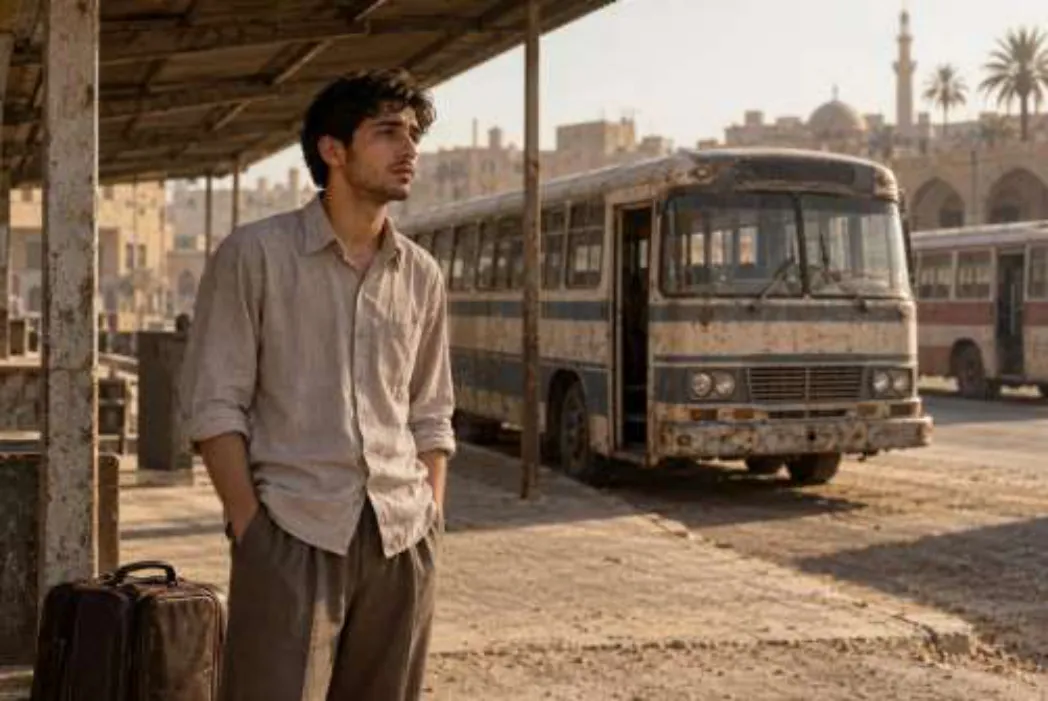
Yusuf found himself forced to go to the bus station in Baghdad to travel on to the city of Basra. The money he had on him was no longer enough to book a seat on any plane bound for Jeddah, and staying on in Baghdad would mean paying for a hotel room, and for taxis to get around the city if he wanted to, and there was nothing in his pocket for whatever he might eat during his stay, should he even think of it. Because his finances were in an unenviable state, he had been obliged to borrow what he thought would be enough from some friends of his who worked at the Saudi embassy, men he had met through his friend Abdullah, whom he had come to know at Jeddah airport and then accompanied to Kuwait. Had the road back to Mecca not been so long and the distance so great, Yusuf would never have asked anyone for any help.
The bus stopped in the city of Wasit, and the passengers got off to pray the noon prayer and eat lunch. Yusuf was not among those who gathered round the tables inside the restaurant; he made do with buying a bottle of water to wet a mouth that had tasted no food since morning, and to keep himself occupied until the passengers had all returned to their seats. When the bus resumed its journey, somewhere on the road to Basra two young men of Pakistani origin holding British citizenship took the seats beside him. He greeted them first, as a way of getting acquainted, and after he had learned their names and they had learned his and the country he came from, and had learned that he, like them, was heading for Basra, they asked him to come along and help them while they were in Basra, since he was an Arab. Without any hesitation he accepted the offer. He had long hoped to get to know this historic city, which he had read so much about in books and studied in his history lessons. There is no doubt of its importance: it is one of Iraq's famous cities, perhaps rivaling Baghdad in renown for the momentous events it has lived through, and its strategic location cannot be denied.

When the bus reached Basra and began winding through its streets toward its final stop, Yusuf saw that this was an old city in every sense of the word. Everything in it bore the mark of age, as if the dust of time had laid on it so thick a coat that it could no longer shake it off its shoulders. Although it was still late afternoon and the sun was still sending out the last of its rays to light some corners and lanes of the ancient city, it seemed sunk in a deep sleep, or as if night had let down its curtains on it early. With every street or quarter the bus passed through, Yusuf grew more convinced that there was no reason for him to stay there a single moment. He did not know the hidden cause that drove him to this overwhelming sense of dejection at the place; perhaps the chief reason was the sight of its streets and its very old houses and its shallow rivers. He could find no explanation for any of it, but he hurried to tell the two Pakistani young men so, and that he would leave Basra for Kuwait at once. And that is exactly what happened.
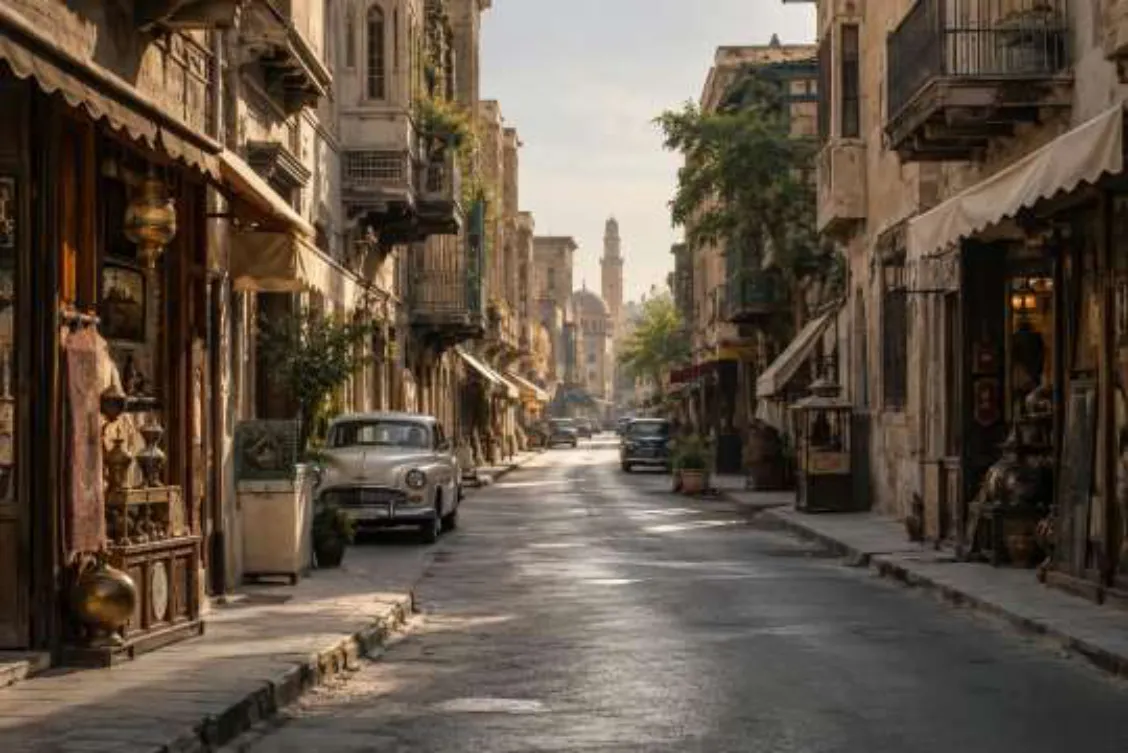
When he had borrowed the money from his friends at the Saudi embassy in Baghdad, he had told them the reason: he had fallen into the trap of one of the many charlatans whose signboards hung on the walls and corners of al-Rashid and al-Sa'doun streets, two of Baghdad's main thoroughfares. He had been wandering through this vast, sprawling city, and curiosity was the strong urge driving him to discover many things, for this was the journey of a lifetime for him, his first time ever outside his own country. In Baghdad and its streets there was much to catch the eye, and many things that would make a man stop again and again, and perhaps tempt him into trying them for the adventure of it. Had it not been for what remained of his faith and his morals, he would have become more and more entangled; but praise be to God, who kept him from falling into further scrapes.
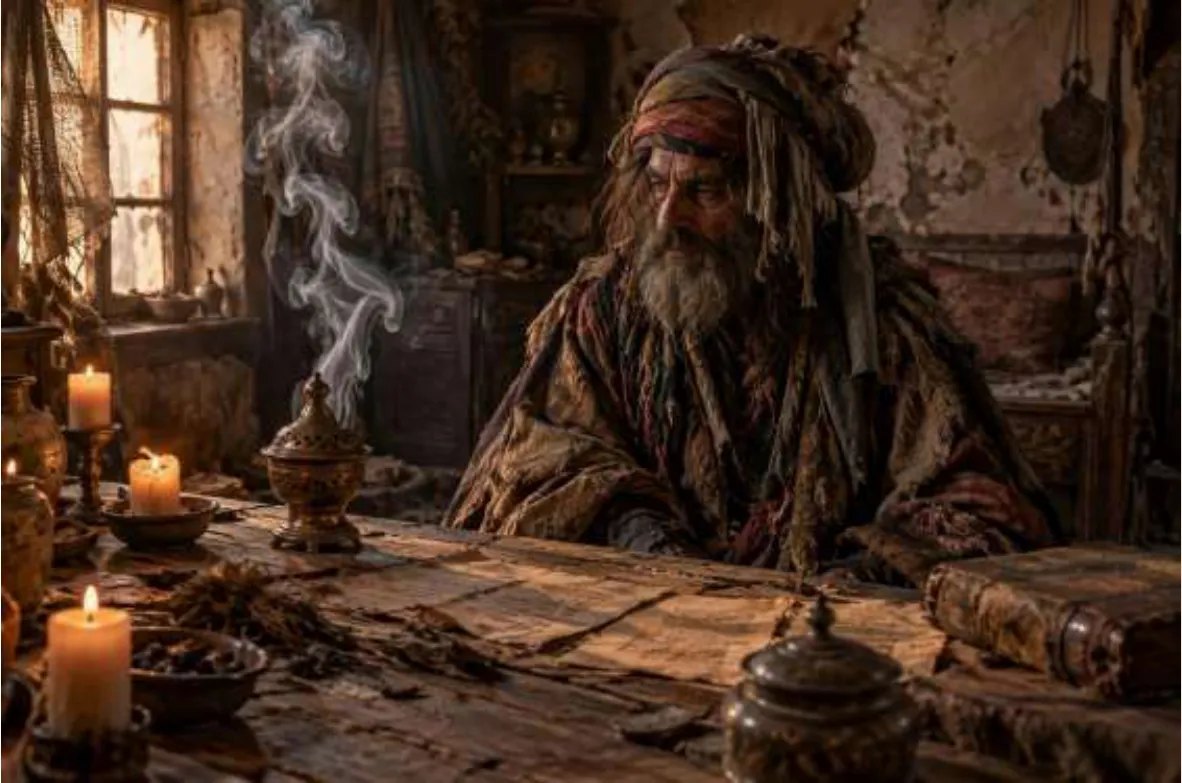
When Yusuf saw how many signboards there were announcing people who claimed to reveal the future and solve problems, and since there was nothing so open as this in his own city of Mecca, he hesitated a long time before embarking on this adventure. But he plucked up his courage and walked into one of these "clinics," if that is the word. Its signboard read: "Abu al-Abbas the Astrologer reveals your future, solves your problems, and helps you fulfil your needs." When he entered its ground floor, where customers were received, he found a group of men sitting, some on a stone bench covered with an old spread, the rest on wooden chairs no less ancient than the bench and its cover. They sat in a courtyard open to the sky, and by the entrance a man sat at a desk like a receptionist. Yusuf greeted those sitting there and they returned his greeting, and the clerk at once asked him what he wanted. He told him he wished to see the Sheikh..!
About an hour after he had come in, when his turn arrived, he went up to the second floor and found Sheikh Abu al-Abbas the Astrologer sitting on a chair with a simple table in front of him and, beside it, what seemed to be the customer's chair; and indeed the Sheikh asked him to sit on the chair facing him. The Sheikh wore a white turban and a brown robe; he had neither beard nor moustache, and he looked healthy and strongly built, a young man, perhaps in his thirties. He asked Yusuf why he had come to him and what he needed, and Yusuf said:
"I study in the psychology department at the university, and in this science we have studied the human soul, its problems, its characteristics and its needs. That is what made me want to learn about what you have and what you do. We were also taught in our country, in our religion classes, that sorcery is forbidden and that charlatanry and witchcraft are not permitted. So could you tell me what it is you offer?"
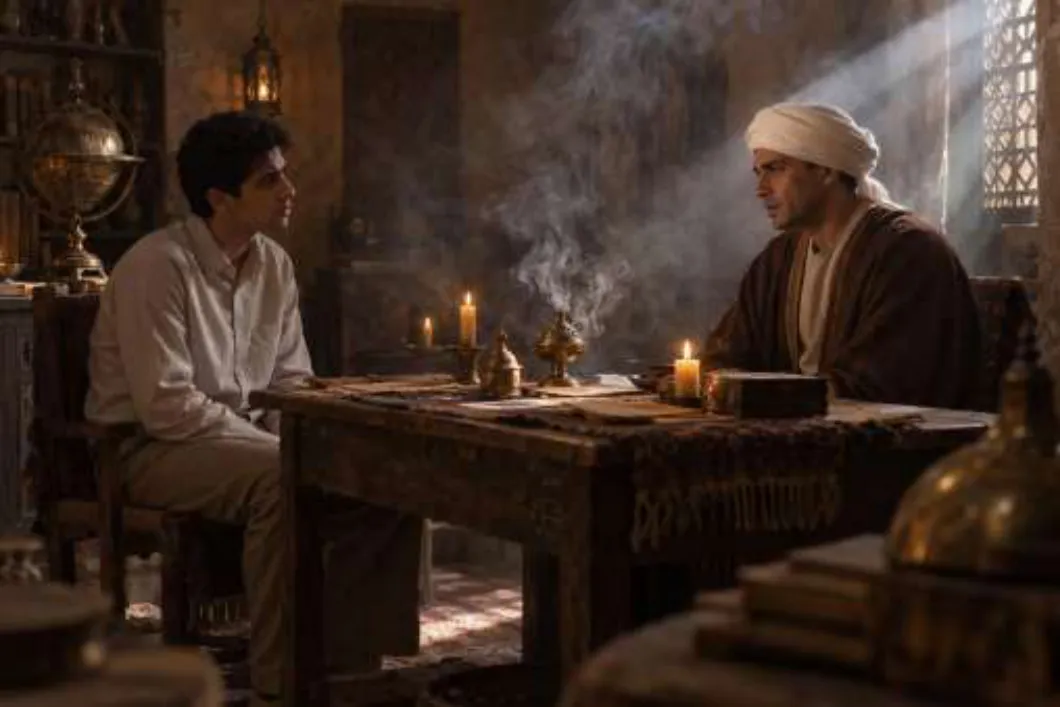
Abu al-Abbas the Astrologer said: "First, I'd like to tell you that what we do and practice is not sorcery. It is the science of spirituality, which we studied at a private institute in the city of Najaf, and it has nothing to do with jinn or witchcraft. We too know that sorcery is forbidden and not permitted. What we do is try to learn what will happen in the future for our customers by reading their palms, and help them solve any problem they face or may face later on. We do not know the Unseen; that belongs to God, and to Him alone..!"
Yusuf did not doubt the man's sincerity for a single moment; he seemed honest and spoke in a confident, frank tone. So when he asked what Yusuf wanted of him, Yusuf said:
"I want to learn how you read palms, because there's nothing like that in my country, and what you do after the reading..!!"
It seems the Sheikh could not believe he had landed such a fat catch. Perhaps his mouth watered when he learned that Yusuf came from the Land of the Two Holy Mosques, the land of oil, and Saudi currency was precious in Iraq. The prey had come to him of its own accord, carried by its own feet and its own desire. But he showed nothing of this, and said to Yusuf: "Ya marhoon, give me your palm so I can read it...!"
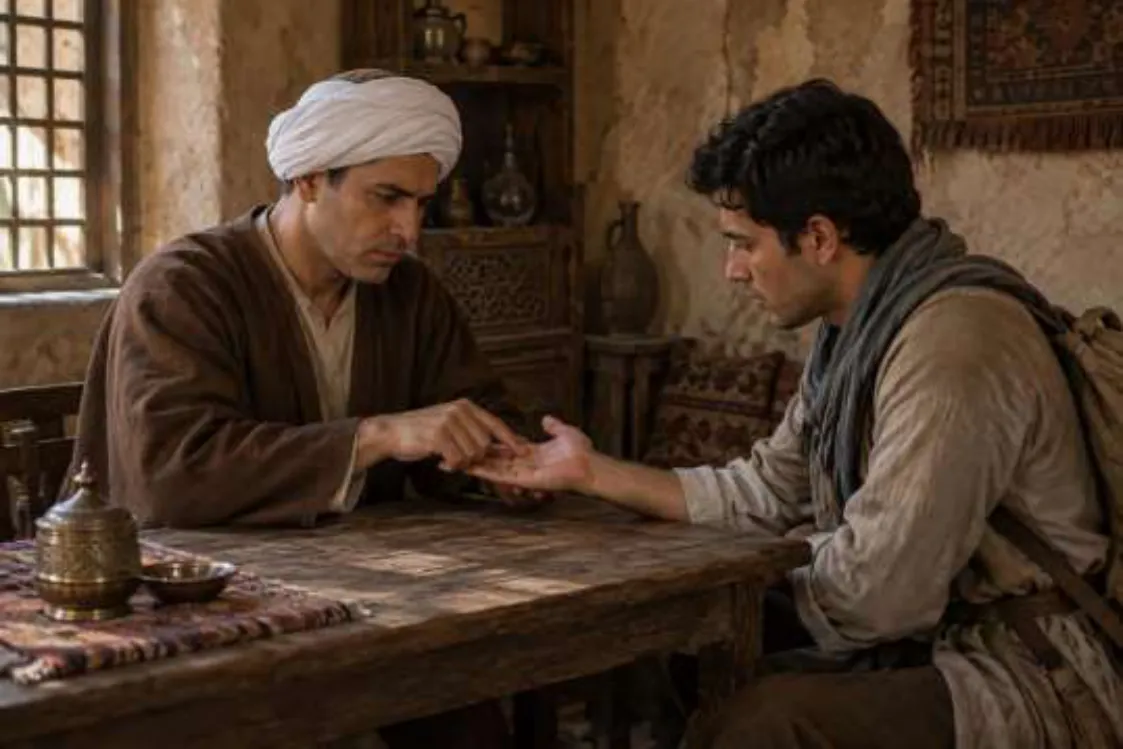
Yusuf held out his right palm, and the Sheikh began to examine it, running his fingers all over it like someone searching for precious treasure. When his tour was done, he said: "Ya marhoon.. you have many problems, and you must solve them, and.." and he went on reeling off a great deal of talk, none of which Yusuf retained, except that he remembers him saying: "Ya marhoon, there is a woman who has worked a spell on you, and this spell will affect your life in the future if you don't undo it. And you have pains in your back that you must treat..!"
Yusuf could not tell truth from illusion. Was what the Sheikh said true? Had a woman really bewitched him? How could he know? What the Sheikh spoke of lay in the realm of the Unseen; there was no way to confirm whether what had been said was true or false, for that was known only to God. Yusuf had come in to the Sheikh merely to see what he was selling, and now he had become a captive of his words. He was seized by such bewilderment that he did not know how to act or what to do. Should he leave the Sheikh and walk out, or go along with him all the way? If he did not heed the Sheikh's advice to undo the spell, would something befall him? Or should he act on the advice and try to break the spell...? But in an attempt to get out of this predicament, he asked the Sheikh: "How much do I pay for the palm reading..?"
The Sheikh answered at once: "A quarter of a dinar. But that means nothing if the problem isn't solved..!"
Yusuf, more bewildered than ever, asked him: "What do I need to do if I want the problem solved..?"
The Sheikh told him: "We must agree on another appointment, so I can give you my full attention and prepare a few things!"
Yusuf found himself in a whirlpool with no beginning and no end, and the more he tried to free himself, the deeper he sank into its mud. As a last attempt to get out of it, he said to the Sheikh: "I'll think about it and come back to you to fix the appointment..!"
He left the place scarcely able to believe it, and on the way back to the hotel confused thoughts took hold of his mind. Would he really go back to the Sheikh, or leave him be? If he did not do what he had been advised, would some harm come to him? And if he followed the advice, would his problems be solved, and would the spell the Sheikh had told him about be lifted..?
When Yusuf reached the hotel overlooking the east bank of the Tigris and went into his room on the ground floor, the only thing he could do was consult his friend Abdullah, who was staying at the same hotel. He picked up the telephone and called his room, but did not find him, since his working day at the embassy was not over. So he prayed the noon prayer at the hotel, then went out and headed for the embassy to have lunch with his friends there at the ambassador's table, which was always laden with every delicious kind of food and drink. On the way his thoughts tossed him this way and that. Would he tell his friends what he had got himself into, or keep it from them unless he felt it necessary? And what would their position be? Would they go along with any step he took with the Sheikh, or would they stand between him and going further into this mess? The short hours passed, lunch ended, and he returned to the hotel with his friend Abdullah without telling him anything. Abdullah went up to his room, and Yusuf went to his own to sink into a deep sleep, hoping he might wake from it with some sound judgment..!
When he woke in the afternoon, he found himself still in the same whirlpool. But after praying the afternoon prayer he hurried into his clothes and left the hotel, making for the Sheikh to tell him what he had decided. And indeed, when he went in to see the Sheikh at his clinic, he agreed with him on the following day, mid-morning, to go on with him down that road..!
When the sun of the next day rose, and after he had eaten breakfast at the hotel, he slung his camera over his shoulder and set out for al-Rashid Street, where the clinic stood. On the way he made no attempt to go back on his final decision, and when he reached the clinic he found its manager waiting for him on hot coals; yet the manager was no more eager for Yusuf than his master, who was waiting on the upper floor. No sooner had Yusuf come through the clinic door than the manager locked it behind him, so that the Sheikh could give him his full attention, as he had said the day before..!
The Sheikh sat studying his fat catch. He had prepared the tools of his trade that he usually used with customers like Yusuf. Before him was a rectangular table covered with a white cloth on which an oval circle had been drawn, along with patterns and talismanic symbols, and on it stood a number of candles. In his hands was a bundle of small slips of paper, rolled in a special way, which were surely going to play some part in the procedure. Yusuf felt there was no escape from finishing the road he had started down of his own accord, with no one pushing him onto it.
Sheikh Abu al-Abbas the Astrologer asked Yusuf to come with him onto the roof next to the room they were in, saying to him: "Ya marhoon.. take these papers and burn them one by one, and as you burn each paper you must name what you want and wish for, and all your wishes will come true and all your problems will be solved, God willing. And you can set whatever time and date you want..!"
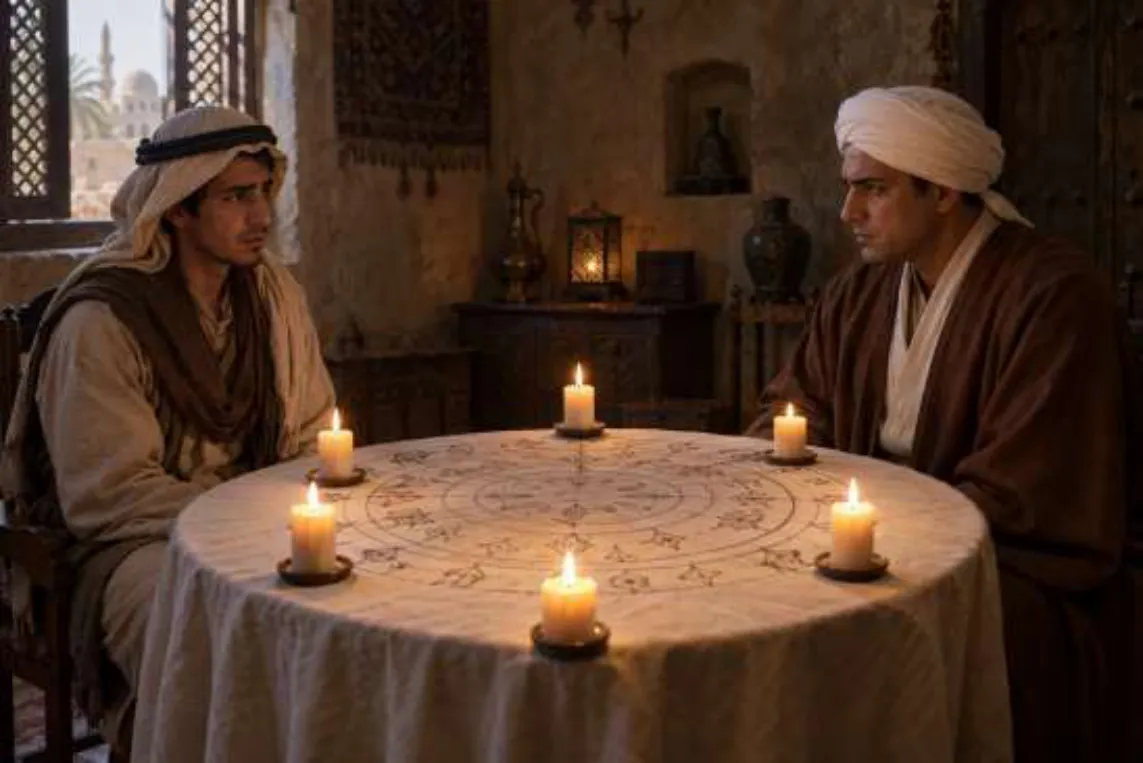
Yusuf had no other choice. He got up and followed the Sheikh as he had been told, and began taking the papers and burning them one after another, naming the time he thought suitable for his wishes to come true and his problems to be solved.
When he had finished burning all the papers, he went back to sit by the table facing the Sheikh, waiting for more demands and orders, and the Sheikh said to him: "Now you are required to make three sacrifices, and you must do it yourself, in the Baghdad cemetery, at night..!!"
Yusuf found himself sinking deeper into the entanglement. The Sheikh had taken him by surprise with this demand, so strange to him, which put him in a bind. But he said to the Sheikh: "I know that it is not permitted to sacrifice to anyone but God. And I'm a stranger here; I don't know how to buy the animals or how to slaughter them, and I don't know the Baghdad cemetery or where it is. Can you help me..?"
The Sheikh did not want to leave Yusuf alone in his whirlpool, and quickly answered his questions: "First, this sacrifice is not to anyone other than God; it is a kind of charity. As for carrying it out, that is your duty, and no one can do it in your place..!"
Yusuf asked the Sheikh again to help him carry out this task. The Sheikh hesitated a little, but showed sympathy for him as a stranger in the country, on condition that Yusuf give him the necessary sum. Yusuf asked him: "And what is the price of the five sacrifices..?"
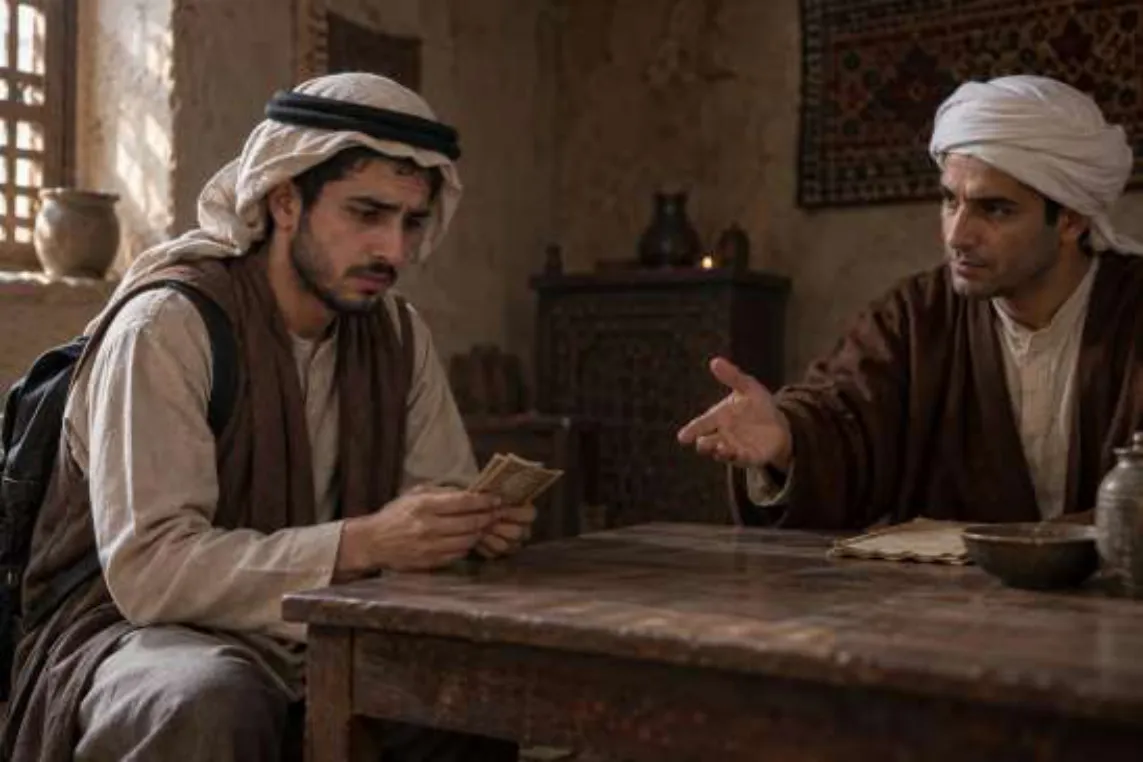
The Sheikh asked him for thirty Iraqi dinars for these sacrifices. Yusuf was taken aback by the size of the sum, for it was most of what remained of the money he had brought with him from home. But he had to pay the Sheikh, and he told him he did not have the whole amount on him now, and that the Sheikh would have to come with him to the hotel to collect it.
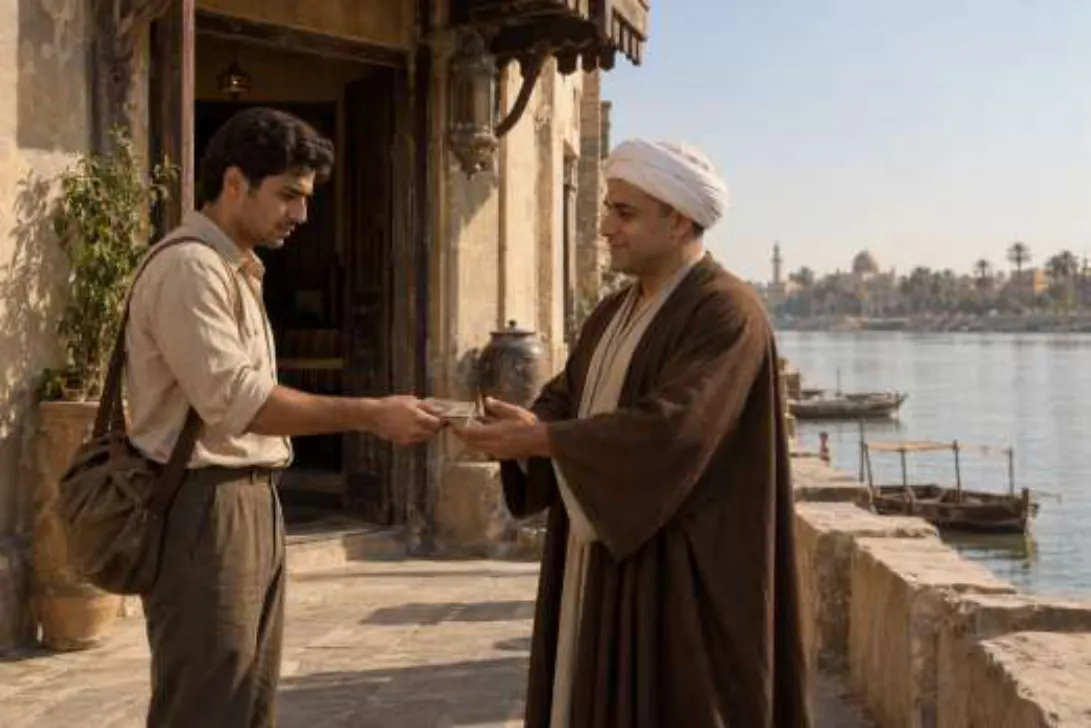
The Sheikh went out with Yusuf, and they took a taxi to the hotel, which stands on the east bank of the Tigris, on Abu Nuwas Street. When they arrived, the Sheikh told Yusuf he could not go in with him and would wait for him in the street. Before many minutes had passed, the sum of three hundred Saudi riyals was in the grip of the Sheikh, who had never dreamed of such money before. No sooner had he taken it than he bade Yusuf a warm farewell, asking him to send him a Saudi thobe as a gift once he got home.
The story as published: View the original Arabic edition (PDF)
How to cite this text
Fathi, Siraj Hussain. “A Charlatan in Baghdad.” 1448 AH. [Arabic: دجال في بغداد.] Siraj Hussain Fathi website, https://siraj.my/en/story.php?id=15 (accessed 24 November 2026).