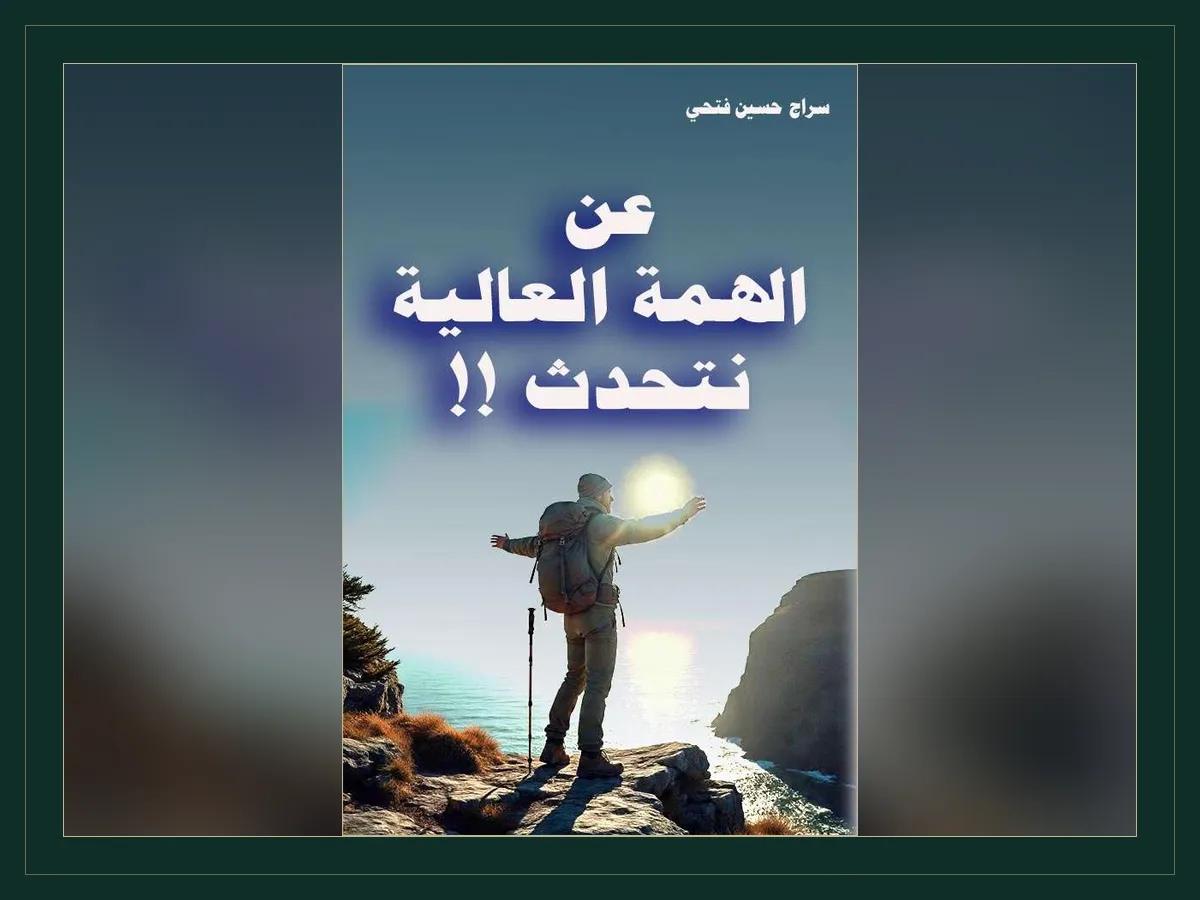
On High Aspiration We Speak!!
A booklet of reflections and conversations by Siraj Hussain Fathi: questions about high aspiration and the Prophet’s example of it, the hadith of the palm seedling as a way of hope, a note on his grandchildren, and what it means to be a role model, with replies from DeepSeek and ChatGPT and a comment by Muhammad Ali Saeed.
And They Ask About High Aspiration?
Does it acknowledge age, or physical condition, or even living circumstances?
Do those who possess it have any time for trivialities?
Do they dream of holidays so they can surrender themselves to sleep?
The Mother of the Believers, Aisha (may Allah be pleased with her), used to say in describing him ﷺ:
When he commanded something, no one acted upon it more than he did; whenever he was given a choice between two matters, he chose the easier of them as long as it was not a sin, and if it was, he was the farthest of people from it; he never took revenge for himself, except when the sanctities of Allah were violated, and when they were violated he was the most intensely angry of people for the sake of Allah; and it always seemed to me as though a banner had been raised for him and he rolled up his sleeves and strove toward it.
Prophetic Episodes of High Aspiration
From DeepSeek
The Prophet ﷺ was greatly harmed in the cause of calling people to Allah, yet he was patient and sought his reward with Allah. Allah the Exalted revealed to him many verses urging him to be patient, keeping him firm upon the truth, and reminding him of the reward of the patient. Among these verses are:
1. Surat An-Nahl – Verse 127:
And be patient, [O Muhammad], and your patience is not but through Allah. And do not grieve over them and do not be in distress over what they conspire.
Guidance: A direct command to be patient, with a reminder that the only source of patience is Allah the Exalted, and a prohibition against grieving over their disbelief or being distressed by their plotting.
2. Surat Taha – Verse 130:
So be patient over what they say and exalt [Allah] with praise of your Lord before the rising of the sun and before its setting; and during periods of the night [exalt Him] and at the ends of the day, that you may be satisfied.
Guidance: The command to be patient in the face of hurtful words is coupled with the command to glorify Allah and worship Him at various times, making patience itself an act of worship and remembrance, and giving the Prophet ﷺ a sense of contentment and closeness to Allah.
3. Surat Al-Qalam – Verses 1 – 7:
Nun. By the pen and what they inscribe, (1) You are not, [O Muhammad], by the favor of your Lord, a madman. (2) And indeed, for you is a reward uninterrupted. (3) And indeed, you are of a great moral character. (4) So you will see and they will see (5) Which of you is the afflicted [by madness]. (6) Indeed, your Lord is most knowing of who has gone astray from His way, and He is most knowing of the [rightly] guided. (7)
Guidance: Strengthening the Prophet ﷺ and refuting the slanders of the polytheists (their accusing him of madness), with the promise of a great, unending reward, the affirmation that he is of a great moral character, and that the final outcome belongs to the God-fearing.
4. Surat Al-Muzzammil – Verses 1 – 10:
O you who wraps himself [in clothing], (1) Arise [to pray] the night, except for a little - (2) Half of it - or subtract from it a little (3) Or add to it, and recite the Qur'an with measured recitation. (4) Indeed, We will cast upon you a heavy word. (5) Indeed, the hours of the night are more effective for concurrence [of heart and tongue] and more suitable for words. (6) Indeed, for you by day is prolonged occupation. (7) And remember the name of your Lord and devote yourself to Him with [complete] devotion. (8) [He is] the Lord of the East and the West; there is no deity except Him, so take Him as Disposer of [your] affairs. (9) And be patient over what they say and avoid them with gracious avoidance. (10)
Guidance: Preparation to bear the burdens of the call (“a heavy word”) by seeking strength in the night prayer and attachment to Allah, followed by the command to be patient with hurtful words and to meet offense with a gracious avoidance in which there is no sin.
5. Surat Al-An'am – Verse 35:
And if their evasion is difficult for you, then if you are able to seek a tunnel into the earth or a stairway into the sky to bring them a sign, [then do so]. But if Allah had willed, He would have united them upon guidance. So never be of the ignorant.
Guidance: Easing the grief over people's turning away from the truth, and making clear that their guidance is not in the hands of the Prophet ﷺ but in the hands of Allah the Exalted, so he should not burden himself with what he cannot bear.
6. Surat Yunus – Verse 109:
And follow what is revealed to you, [O Muhammad], and be patient until Allah will judge. And He is the best of judges.
Guidance: A command to hold firm to the revelation without compromise, and to be patient until Allah the Exalted judges, for He is the wisest of judges, which suggests that victory is surely coming.
7. Surat Ghafir – Verse 55:
So be patient, [O Muhammad]. Indeed, the promise of Allah is truth. And ask forgiveness for your sin and exalt [Allah] with praise of your Lord in the evening and the morning.
Guidance: Linking patience to the true promise of Allah the Exalted (of victory and empowerment), which kindles hope and drives one to persevere.
Summary of the Lessons Drawn from These Verses
- Patience is worship: it is indispensable on the path of calling to Allah.
- Reliance on Allah: He is the true helper in being patient (“and your patience is not but through Allah”).
- Taking refuge in Allah through worship: (glorification, the night prayer) is the source of strength and steadfastness.
- Certainty in Allah's promise: confidence that Allah's victory is coming makes the hardships of the path easier.
- Good character in response: meeting offense with gracious avoidance, not with its like.
- Entrusting the matter to Allah: knowing that guidance is in the hands of Allah the Exalted lightens the burden of grief over people's turning away.
These verses were a solace for the Prophet ﷺ and a weapon with which he fought the worries and hardships of the call, and for the believers after him they are a light that guides them on the path of calling to Allah.

From ChatGPT
The Prophet ﷺ was the loftiest of people in aspiration and the greatest of them in resolve, and this high aspiration manifested itself in many episodes of his life, among them:
1– At the beginning of the call:
When he climbed Mount Safa and proclaimed the call openly, challenging all of Quraysh despite the mockery and harm he met, and spoke his great words to his uncle Abu Talib: “By Allah, O uncle, if they were to place the sun in my right hand and the moon in my left on condition that I abandon this matter, I would not abandon it until Allah makes it prevail or I perish in its cause.”
2– His patience in Taif:
When he went to Taif seeking support, they turned him away in the worst manner and pelted him with stones until his blood flowed; yet he did not give in, but said in his supplication: “If You are not angry with me, then I do not care,” so his aspiration rose above wounds and abandonment.
3– His steadfastness in the battles:
- At the Battle of Badr he went out with only three hundred fighters to face an army three times their size, seeking Allah's help and certain of victory.
- At the Battle of Uhud he stood firm on the battlefield when some of his Companions were routed and scattered.
- At the Battle of Hunayn he stood firm, saying: “I am the Prophet, no lie; I am the son of Abd al-Muttalib.”
4– In worship:
He used to stand in prayer at night until his feet became cracked, and when it was said to him: “Your past and future sins have been forgiven,” he said: “Should I not be a grateful servant?” This is an aspiration in worship in which no one can match him.
5– In bearing the burdens of the message:
He used to go around among the people during the Hajj season, presenting himself to the tribes and calling them to Islam, never despairing and never tiring, until a man said: “I have never seen anyone more devoted to his companions than Muhammad.”
6– In his daily life:
He lived austerely, eating whatever he found and wearing whatever was available, leading the nation himself, fighting alongside them and serving his family at home, even though he was the leader of the world — which shows his high aspiration and his humility at one and the same time.
DeepSeek Says
High aspiration is that sharp, cutting sword that splits the darkness of laziness and weakness; it is a fire blazing in the heart of its owner, burning away every excuse and every barrier between him and lofty things.
So I will answer your questions as briefly as a glance:
1. Does it acknowledge age or circumstances?
High aspiration does not acknowledge age; old age does not prevent aspiration, and youth does not guarantee it.
Nor does it acknowledge circumstances; it is born from the womb of hardship.
The Prophet ﷺ said: “Strive for that which will benefit you, seek the help of Allah, and do not give up.”
So the matter is: striving + seeking help + refusing helplessness. This is the law of aspiration.
2. Do those who possess it have time for trivialities?
They have no time for trivialities, because great hearts have no room for pettiness, and lofty souls do not busy themselves with trifles.
Their concern is focused on what comes after death, on what is with Allah, and on benefiting people.
One of the wise said: “Whoever's aspiration is great, everything less than Allah becomes small in his eyes.”
3. Do they dream of holidays so they can surrender themselves to sleep?
Their sleep is little, but Allah's blessing in it is abundant. Their holiday lies in changing the kind of work from one act of worship to another, not in ceasing from it.
The early generations (the Salaf) used to say:
“My soul yearns for Paradise, so I take it in hand with fasting and prayer.”
Their rest is in obeying Allah, and their occupation is with that for which they were created.
In sum:
High aspiration is a divine fire kindled in living hearts; it is not extinguished by youth, nor by old age, nor by poverty, nor by illness.
Those who possess it are not angels but human beings — yet human beings whom Allah has brought to life with the meanings of servitude to Him and stewardship on earth.
They do not wait for holidays; rather, they wait for the moment when they meet Allah with the best of deeds.
Allah the Exalted says: ﴿But whoever desires the Hereafter and exerts the effort due to it while he is a believer - it is those whose effort is ever appreciated [by Allah].﴾ [Al-Isra: 19].
So high aspiration is: striving for the Hereafter, through striving in this world, with the intention of a believer.
And ChatGPT Says
The questions you have raised are very profound, like a window onto the meaning of high aspiration — that hidden power which lifts a person above the constraints of body, time and place.
✦ High aspiration does not acknowledge age:
How many a young man in the prime of life whose heart died before his body did, and how many an old man past eighty you find overflowing with giving as though he were in the full bloom of youth.
✦ Nor physical condition:
Willpower may dwell in a weak body yet work wonders through it. How many a disabled person or amputee has become a beacon among people through his aspiration.
✦ Nor straitened living:
For the greatest of the great came from poor homes, yet they carried a wealth of ambition, faith and work.
✦ And those who possess it have no time for trivialities:
For great minds are occupied with lofty things; they do not stoop to pick up the crumbs of quarrels and follies.
✦ Nor do they know the “holiday” as a form of escape:
For rest, to them, is a renewal for setting off again, not a withdrawal from the field. Their sleep is provision for a longer wakefulness, and their holiday is thinking about a higher step.
High aspiration, simply put: a perpetual journey toward the heights, not bound by age, not broken by circumstances, and not tempted by trivialities.
The Palm Seedling: A Way of Hope
If the Hour is established while one of you has a palm seedling in his hand, then if he is able to plant it before the Hour is established, let him plant it.
Narrator: Anas ibn Malik | Hadith scholar: Al-Albani | Source: Sahih | Summary of the scholar's ruling: Sahih (81), and Al-Bazzar (7408) with slight variation.

Explanation of the Hadith and Its Greater Aims (from the Dorar.net website)
The Islamic Sharia has encouraged the cultivation and development of the earth, just as it has urged the Muslim to be positive in all his circumstances and to be beneficial to himself and to others. The Prophet ﷺ urged every act of righteousness, kindness, charity and benefit to others, even if the doer does not see its fruit, as he said in this hadith: “If the Hour is established”,
meaning: if one of you is certain that the Day of Resurrection, with its signs and characteristics, has come, “while one of you has a palm seedling in his hand”, meaning a small young palm plant, “then if he is able to plant it before the Hour is established, let him plant it”, meaning let him plant it in the soil and not abandon doing good and benefit. This is an emphatic exaggeration and an exhortation to do good even in the darkest of circumstances, even if the doer thinks no benefit will come of it.
Among the kinds of good are planting trees and digging wells, so that the world remains flourishing until the end of its term. Just as others planted what you ate your fill from, so plant for those who come after you. The Prophet ﷺ mentioned in other hadiths the virtue of planting and cultivation, because of the food it provides for people, birds and animals, and because of the sustenance it secures. This hadith also shows that a person doing good with his own hands is a praiseworthy thing.
And in the hadith: an exhortation to continue doing good until the very last moment of one's life.
DeepSeek's Commentary
O soul that has made its ablution in the lights of morning, O heart that beats with renewed hope, listen with me to this great Prophetic counsel that raises our aspiration above the limits of time and makes us partners in good even after we depart: “If the Hour is established while one of you has a palm seedling in his hand, then if he is able to plant it before the Hour is established, let him plant it.”
Imagine.. the world on the brink of its end, everyone in shock and terror, and you standing there with a small seedling in your hand.. What will you do?
The hadith does not command you merely to save yourself; it commands you to plant.
This is the aspiration of immortality, known only to those who believe in the work itself as a value and an end, not in the immediate result.
Planting here is faith rising above despair, and will triumphing over futility. It is you saying to the universe:
“After me will come human beings, a bird will eat from this tree, and a person will shelter in its shade.. and I will remain a partner in its reward even after I am gone.”

So what is the “seedling” in your hand today?
- Is it a good word you plant in someone's heart?
- Is it knowledge you spread in a newspaper or on a platform?
- Is it a charitable project you leave for generations to come?
- Is it a righteous child who prays for you in your absence?
- Is it reconciling two people?
- Is it a mark of hope on someone's day?
Do not say: “What is the use of planting when the world is passing away?”
Rather, say: “How beautiful it is to plant because the world is passing away!”
The hadith reminds us of the Hour in order to awaken in us a sense of responsibility, not of despair, and it urges us toward quality in our work, not quantity.
It is the great philosophy of Islam: “Work for your worldly life as if you will live forever, and work for your Hereafter as if you will die tomorrow.”
So do not postpone planting your seedling.. do not wait for ideal conditions.. do not say I will start tomorrow..
Start now.. and plant.. for you do not know which seedling will be the cause of saving a human being, or the cause of your reward continuing to drift gently between earth and sky even after you are gone.
O Allah, make us among those who listen to speech and follow the best of it, make all our deeds righteous and sincerely for Your Face, and let no one have any share in them. A good morning, and a high aspiration that knows neither laziness nor despair.
My Dear Grandchildren
Six years ago, my granddaughter (Ruba) (who was still in intermediate school) got up from beside me after a wide-ranging chat, and said to me as she climbed the stairs: Thank you, my great grandfather!
Words that came sincerely from her heart, expressing how attached she is to me and how bonded I am to her emotionally. She has been cultured since she was in primary school — as her teachers attest!
And more than a month ago, my granddaughter Bushra said to me, after a wide-ranging chat: Thank you, my great grandfather!
And a week ago, my grandson Muhammad Jamal (who is now in the third grade of primary school) came to me, pulled up a chair and set it in front of the seat I was sitting on: Let's talk together!
And indeed, he laid out before me some good questions, and I engaged with him, and it was a lovely session!
These three scenes are some of the blessings Allah has bestowed on me in the kind of relationship I have with my granddaughters and grandsons, which gives me a beautiful pleasure that eases some of the sorrow we are living through at this stage!
Perhaps it is fitting to mention that my father was deprived of the pleasure of sitting with his father — my grandfather Abdullah — because he died while my father was still very young; consequently, I was deprived of seeing my grandfather himself and enjoying sitting with him. As for my maternal grandfather, although he was pleasant company and light-hearted, that was only with my father; with me, because he was my teacher in the first grade of primary school, his dealings with me were almost formal.
This reflection is meant to shed light on the importance of opening spaces for dialogue and conversation between fathers, grandfathers, children and grandchildren, because everyone needs everyone!
The elderly find with their little ones a pleasure that renews their vitality and revives hope in their souls, and the young find in their elders what makes them feel their humanity and raises their standing.
Perhaps among the most important benefits of the two sides coming together is the passing on of experience and lessons between generations, and sparing the young the dangers of repeating the mistakes of those before them, which would negatively affect their psychological and social formation!
My father, may Allah have mercy on him, used to enjoy sitting with the little ones, and they found comfort and reassurance with him.
I hope my message has reached those whom it concerns!
What Does It Mean to Be a Role Model?
It is not easy for a person to place himself in the position of a role model if he is not qualified for it!
Because this position is very great, and it has its qualities, requirements and responsibilities!
Because a role model will be in the sights of both eyes and hearts!
It is not enough to be elegant in your clothes and appearance to become a role model, for these outward forms may hide a devil behind them!
It is not enough to become a role model through your many smiles and your lavish generosity in handing them out to those around you, for they may be mere decoration concealing a hateful heart behind them!
You cannot be a role model while your mind is empty and your desires are tossed about by storms of lusts and base intentions!
It is impossible to become a role model without possessing distinguished skills in the affairs of religion and of this world!
It is hard to sit on the throne of the role model when you have no bright record of positive achievements and excellence in aspects of life that benefit those who follow your example!
It is not enough to be diligent in performing the rites of worship while you practice all kinds of injustice and unfairness toward those who work with you or for you!
DeepSeek's Commentary
What it means to be a true role model
You are entirely right in your profound observations. Being a role model is not a position one asks for; it is a great moral responsibility imposed by deeds, not words.
Qualities of a true role model
A true role model is distinguished by:
- Balance between appearance and essence: outward elegance is not enough without inner beauty.
- Consistency between word and deed: no contradiction between the rites of worship and daily dealings with people.
- Wisdom and knowledge: a deep understanding of the affairs of both religion and this world.
- Moral integrity: an inner uprightness that shows both in public and in private.
- Achievement and giving: a rich record of positive contributions to society.
Challenges facing a role model
- Constant scrutiny: the role model is under the microscope of onlookers.
- The responsibility of continuity: maintaining a high moral standard consistently.
- Facing human imperfection: admitting error and shortcoming when they occur.
How we deal with the idea of a role model
- A role model is not infallible: one can follow a person's example in certain aspects and not in others.
- The relative role model: every person can be a role model in his field of specialty or in a virtue he has mastered.
- Integration, not perfection: we do not demand perfection from any human being, but we follow the example of those who strive on the path of uprightness.
A true role model is one who realizes the weight of the responsibility and strives for continuous improvement, with enough humility to know that perfection belongs to Allah alone.
And ChatGPT Says
Your words are profound and direct 👌
You have sincerely drawn the features of the true role model, as if warning against the false role model who deceives people with appearances.
We can complete the meaning you put forward by saying:
To be a role model means to be a living image of the values you believe in, so that when people see you, morals are embodied in you before words. It is not merely neat attire, nor contrived smiles, nor rites isolated from conduct; rather, it is:
1. Inner authenticity before outer beauty
Hearts perceive what lies behind the masks, and so they recognize your sincerity or your falseness.
2. Awareness and a well-grounded mind
A role model is not swept along by lusts nor driven by whims; rather, he possesses an insight that lights his way and the way of those around him.
3. A record of achievements
That people see a beneficial impact from your knowledge, your work, your giving and your reform, not merely words flying about.
4. Justice and uprightness
That you not be one who prays, fasts and oppresses; rather, that your faith be translated into mercy and fairness in your home, your surroundings and your work.
5. Responsibility before Allah and before people
Because when you choose to be a role model, you have placed yourself in a position of constant testing, and eyes watch you consciously and unconsciously.
In short:
The true role model lies not in “appearance” nor in “words”, but in the coherence and balance of the personality: an aware mind, a pure heart, fruitful work and upright conduct.
Brother Muhammad Ali Saeed Says
The question that precedes this.. does a person appoint himself a role model.. or is it people who choose whom they follow as an example.. In my opinion the second is closer to the truth.. and so there is no need for all that you have kindly set out, despite the importance of disciplined conduct for everyone, whether people take him as a role model or not..
And speaking of role models, taking a certain person as a role model does not mean that he is righteous.. indeed, there are many righteous people whom hardly anyone knows to be righteous, let alone takes them as role models..
DeepSeek's Commentary
The question of choosing a role model: between self-appointment and selection
I fully agree with your precise analysis; the question of role models is more complex than it appears:
The social selection of role models
- People choose their role models based on their psychological and value-based needs.
- Role-modeling is a selective process in which society chooses partial models to follow in specific aspects.
- The unintended role model is often more influential than deliberate attempts.
The difference between righteousness and being a role model
- Righteousness is an inner state, whereas being a role model is tied to social perception.
- Invisible righteous people: as you kindly noted, many righteous people live in obscurity despite their moral greatness.
- A visible role model may hide shortcomings, just as not being visible does not mean having no influence.
A balanced conclusion
- Moral discipline is required for its own sake, not in order for one to become a role model.
- Influence happens unintentionally, for our conduct leaves an impact whether we want it to or not.
- Intention is the decisive factor, for what counts is sincerity, not visibility.
As the Prophet ﷺ said: “Indeed, Allah does not look at your forms and your wealth, but He looks at your hearts and your deeds” (narrated by Muslim).
What matters most is the uprightness of heart and conduct; as for a person being a role model, that is a social choice that may or may not happen, and it is not a measure of true moral worth.
Prepared and designed by Siraj Hussain Fathi. Download the full file as PDF